
Adaptogen Stacking-Benefits and Risks: Rhodiola, Ashwagandha, and More. Why Traditional Context, Preparation, and Application Matter More Than Modern Stacks
In today’s high-pressure world of constant notifications, demanding careers, and endless to-do lists, chronic stress has become perceived as a near-universal experience. Many people turn to natural solutions for resilience, energy, and balance. Enter adaptogens—herbs and plants traditionally used to help the body “adapt” to physical, mental, and environmental stressors.
Adaptogen stacking is the modern practice of combining herbs, roots, mushrooms, or plant extracts such as Rhodiola for daytime energy and Ashwagandha for evening calm. Marketed as a sophisticated, “natural” way to build resilience against modern stress, these stacks promise better focus, lower cortisol, improved recovery, and balanced energy. On the surface the approach looks elegant. In reality it often strips the plants of the very frameworks that made them useful for centuries and turns them into something closer to a daily over-the-counter habit.
This look at adaptogen stacking keeps the core discussion of benefits and risks but shifts the emphasis where it belongs: to traditional context, traditional methods of preparation and application, and the measurable ways those methods support absorption, physiological balance, and long-term safety. It also draws a clear parallel to an earlier era of pharmaceutical cycling that many readers will recognize.
Taking one adaptogen can feel simple. Taking three or four at once can feel like building a personal stress-support formula, but it can also make it harder to know what is helping, what is too much, mask the real culprit, and what is quietly working against the rest of your routine.
The appeal is easy to understand. Stress is rarely one-note. It can show up as fatigue, tension, poor sleep, low mood, scattered focus, or that wired-but-tired feeling after a long week. A thoughtful stack may address more than one layer. A careless stack can create overlap, side effects, or confusing signals.
This guide looks at the holistic benefits, the risks of overuse, and a practical way to use adaptogens with more care. The more these plants are framed as everyday OTC solutions for the friction of everyday life, the more they risk repeating older patterns under a green washed label. Questioning the hype and insisting on traditional context is a reasonable and protective stance.
This article is for informational purposes only and is not medical advice. Adaptogens can interact with medications and health conditions, so speak with a qualified herbalist before you begin and a clinician if you are pregnant, nursing, managing a medical condition, or already taking other prescriptions.

What Are Adaptogens?
The term “adaptogen” originated in the mid-20th century from Soviet research. Russian scientist Nikolai Lazarev and later researchers defined adaptogens as substances that increase the body’s non-specific resistance to stress, normalize physiological functions (whether over- or under-active), and are relatively non-toxic at normal doses.
True adaptogens typically work by modulating the hypothalamic-pituitary-adrenal (HPA) axis—the body’s central stress-response system—and influencing related pathways involving cortisol, neurotransmitters (such as serotonin, dopamine, and GABA), inflammation, and cellular stress proteins. They do not act like stimulants (which can lead to crashes) or sedatives (which can dull alertness). Instead, they aim for balance.
Classic examples include:
Rhodiola rosea (golden root or arctic root),
Ashwagandha,
Eleutherococcus senticosus (Siberian ginseng or eleuthero),
Panax ginseng, Schisandra chinensis,
Holy Basil (Ocimum sanctum or tulsi), and
Certain mushrooms like Cordyceps.
Evidence quality varies widely: Ashwagandha and Rhodiola have the strongest modern clinical support among commonly used options, while others rely more on traditional use for justification and smaller or older studies.
What adaptogens are meant to do
Adaptogens as a category of plants and fungi are used in herbal traditions to help the body adapt to stress. The term usually refers to substances that support resilience without pushing the body too far in one direction.
In plain language, adaptogens are often used to support:
Stress response
Energy and stamina
Mental focus
Sleep quality
Mood balance
Recovery after strain
They are not stimulants in the same way caffeine is. They are also not sedatives in the way sleep medications are. Many people use them because they feel more subtle, steady, and whole-body in their effects.
A good adaptogen stack should have a reason. It should not be a long list of every herb that sounds calming, energizing, or “balancing.”
The most common reasons people stack adaptogens
Stacking can make sense when the herbs have different roles and there is a comprehensive plan with specific goals. The goal is not to cover every possible benefit. The goal is to support the body during the pattern that is actually present.

Popular adaptogens and where they may fit
Different adaptogens have different personalities. That does not mean they work the same way for every person, but it gives a useful starting point.
Beyond the Duo: Other Notable Adaptogens
Stacking often expands beyond these two. Common additions include:
Holy Basil (Tulsi): Milder stress support, potential benefits for blood sugar and mild anxiety; less robust clinical data than the top two.
Eleuthero (Siberian ginseng): Traditional for endurance and immune resilience; modern English-language evidence is weaker than its Soviet-era reputation.
Panax (Korean or Asian) ginseng: Energy, cognitive support, and vitality; can be more stimulating.
Schisandra: Traditional for liver support, endurance, and “five-flavor” tonic effects.
Cordyceps: Focused on physical energy, ATP production, and athletic performance.
Reishi: Relaxation, immune-support traditions, sleep routine
Maca: Vitality, mood, hormonal wellness traditions
These can fill specific gaps—e.g., Cordyceps for training endurance or Schisandra for broader tonic effects—but stacking more than two or three increases complexity and the chance of overlapping or opposing actions. The right stack depends on health history, sensitivity, sleep, medications, and the reason for taking adaptogens in the first place.
The Holistic Benefits of Thoughtful Stacking
When done carefully, stacking can offer synergistic or complementary support for broader stress modulation. Ashwagandha’s cortisol-lowering and calming effects pair with Rhodiola’s anti-fatigue and cognitive support. Users often describe more even energy, reduced burnout feelings, and better handling of both acute deadlines and chronic pressure. Some multi-ingredient trials (including combinations with holy basil or Schisandra) have shown reductions in perceived stress, improved sleep, and better mood scores versus placebo.
Energy and performance without extremes.
Rhodiola supports mental clarity and physical stamina during the day; Ashwagandha aids recovery and sleep. Athletes and high performers sometimes report better training consistency and recovery. Evidence for Ashwagandha in strength and aerobic capacity is among the stronger adaptogen findings; Rhodiola shines more for perceived exertion and fatigue resistance.
Mood, sleep, and cognitive support.
Combined use may stabilize mood, reduce stress-related anxiety or low motivation, and improve sleep architecture via Ashwagandha while preserving daytime alertness via Rhodiola. Cognitive benefits under load (focus, reduced mental exhaustion) are more consistently linked to Rhodiola.
Potential wider physiological effects.
Some adaptogens show preliminary data for immune modulation, antioxidant activity, mild thyroid or reproductive hormone support (Ashwagandha), and mitochondrial function (Cordyceps). In a holistic sense, better stress handling can cascade into improved metabolic health, reduced inflammation markers, and greater overall vitality—provided foundational habits (sleep, nutrition, movement, social connection) are also addressed.
Importantly, most benefits for stacking remain extrapolated from single-herb data and mechanistic complementarity, rather than large head-to-head stacking trials. Individual responses vary widely based on genetics, baseline stress load, extract quality, and concurrent lifestyle factors.
Support consistency
Some people do better with a small, repeatable daily routines. A morning tea, an afternoon tincture, or an evening capsule can become a cue to pause, breathe, and evaluate the cause of the nervous system dysregulation.
That pattern matters. Adaptogens may support stress response, but they work best alongside the basics:
Enough sleep
Regular meals
Protein and fiber
Sunlight and movement
Time away from screens
Honest limits on caffeine and alcohol
Adaptogens are support tools, not a substitute for recovery. If life keeps demanding more than the body can give, no stack can fully solve that.
Combine different traditional uses
Adaptogens come from different herbal systems and have different histories. Ashwagandha has strong roots in Ayurveda. Rhodiola has a long history of use in cold, mountainous regions. Reishi has deep ties to East Asian herbal traditions.
Stacking can bring these traditions together, but it should be done with respect. More ingredients do not automatically mean more wisdom. Traditional formulas often use specific ratios, preparations, and companion herbs. Random mixing is not the same as a trained herbal approach.
What Traditional Systems Actually Did
Modern adaptogen stacking - combining concentrated extracts or capsules for broad stress resilience is largely a contemporary wellness trend. Traditional systems—Ayurveda, Tibetan medicine, Siberian/Russian folk practice, Traditional Chinese Medicine (TCM), and European herbalism—used these plants differently: often as single herbs or in very specific multi-herb formulas, at moderate doses, prepared in particular ways (decoctions, milk vehicles, alcohol infusions), matched to constitution, season, or clear symptoms, and frequently as food or tonic rather than daily high-potency isolates.
Traditional use of these plants looked markedly different.
Rhodiola rosea (Golden Root / Arctic Root / Rosenroot) Traditional context:
Long used in Siberian, Scandinavian, Tibetan, Mongolian, and Russian folk medicine (and noted by Dioscorides in the 1st century for headache). It was valued for physical endurance, work capacity, resistance to cold/altitude, fatigue, depression, colds/flu, gastrointestinal issues, infections, and fertility. In Siberia, roots were given to newlyweds for vitality and healthy offspring. Vikings reportedly used it for strength. Tibetan use focused on lung conditions; Scandinavian use included scurvy and hair washes. It was also eaten as food (leaves/stems pickled or cooked; roots as a refreshing agent).Traditional preparations/recipes:
Decoction: 1–2 teaspoons dried root simmered in water for 10–15 minutes (sometimes longer for deeper extraction). Drunk as a daily tonic or for fatigue.
Alcohol infusion/tincture: Sliced roots steeped in vodka, local spirits, yak milk, or honey.
Combined: With sea buckthorn, lingonberry, or pine tips in some northern traditions; topical decoction as hair wash.
Food use: Young leaves/stems eaten raw or cooked; roots pickled.
Traditional use was often seasonal, for specific demands (long journeys, harsh winters), or in modest amounts rather than continuous high-dose extracts.
Ashwagandha (Withania somnifera)Traditional context:
A premier Rasayana (rejuvenative) and Balya (strength-building) herb in Ayurveda for over 3,000 years (mentioned in Charaka Samhita, Sushruta Samhita, and other classical texts). Used for weakness, emaciation, insomnia, stress/anxiety (especially Vata imbalance), reproductive health (spermatogenic, libido, fertility support), nervous system tonification, arthritis, and general longevity/vitality. It nourishes tissues (dhatus), builds muscle, and supports recovery. Not primarily a “daytime energizer” but a grounding, nourishing tonic—often evening use.
Traditional preparations/recipes:
Classic Ksheerapaka (milk decoction): ½–1 teaspoon (or 3–6 g) root powder simmered in warm milk (sometimes mixed with water), reduced, then mixed with a little ghee and sweetened with honey or jaggery. Taken before bed for strength, sleep, and rejuvenation. Milk and ghee act as lipid carriers that improve absorption of the plant’s withanolides and other lipophilic compounds while simultaneously grounding and nourishing the tissues.
Powder (churna) with warm water, honey, or ghee (morning or evening).
Medicated ghee (Ashwagandha Ghrita) or herbal jam (lehyam) preparations for deeper nourishment.
Simple decoction or paste for external use on joints/swelling.
Often combined with pungent herbs (e.g., pippali/trikatu) or other rasayanas rather than isolated high doses.
Classical dosages were modest (commonly 3–6 g powder daily) and delivered with nourishing vehicles that aid absorption and balance the herb’s properties.
Holy Basil / Tulsi (Ocimum sanctum / O. tenuiflorum)Traditional context:
Sacred in Hinduism/Ayurveda (mentioned in the Rig Veda); used for respiratory issues, fevers, stress, inflammation, digestion, and as a spiritual “protector.” Also important in Thai, Chinese, and African traditions. Leaves embody light/dry qualities; used for clarity, mood, and immune support.
Traditional preparations/recipes:
Simple leaf tea/infusion: Fresh or dried leaves steeped in hot water (often with honey, lemon, or other herbs like rose or lemon balm).
Culinary: Fresh leaves in Thai stir-fries (pad kra pao), curries, or salads; seeds in drinks.
Other: Root powder in milk/ghee; infused honey or oxymels; juice or wine-like preparations.
Ritual/culinary blends: Combined with spices for chai-style drinks or as a daily household tonic.
Other Adaptogens Mentioned (Schisandra, Eleuthero, Cordyceps, Ginsengs)
Schisandra chinensis (“five-flavor fruit”): TCM superior tonic for longevity, energy, cough, fatigue, and as a male sexual tonic (Shen Nong Ben Cao Jing). Russian/Siberian Nanai hunters used berries/seeds for stamina, reduced thirst/hunger, and night vision. Traditional: Dried fruit as powder (1.5–6 g/day), ethanolic tincture, or decoction.
Eleuthero (Siberian ginseng, Eleutherococcus senticosus): Soviet-era and Far Eastern tonic for fatigue, endurance, and immune resilience; used similarly to ginseng but milder. Preparations: Root decoction or extract.
Cordyceps (Ophiocordyceps sinensis and allies): Tibetan medicine (at least 15th century) and later Chinese materia medica for kidney/lung support, vitality, sexual fluids/fertility, and fatigue. Traditional: Cooked in soups, with meats, or as powder/decoction (often with other tonics).
Ginsengs (American Panax quinquefolius and Asian P. ginseng): TCM qi tonics (American more cooling/yin-nourishing; Asian more warming). Decoctions of root (often 3–9 g), teas, or cooked in broths/soups. Native American uses of American ginseng were more limited/tonic.
These methods were not primitive approximations of modern extracts. They were deliberate technologies for proper absorption and balance. Decoction of roots liberates compounds that simple steeping misses. Lipid vehicles (milk, ghee, oils) enhance bioavailability of fat-soluble constituents and temper the herb’s energetic qualities. Combinations and anupanas (vehicles) reduce the risk of excess stimulation or excess sedation. Cyclical or situational use prevents the body from adapting in ways that diminish effect or create rebound.
How Traditional Preparation Supports Bodily Function
When these plants are taken as concentrated extracts in isolation, several traditional advantages disappear:
Absorption and bioavailability: Many active constituents in Rhodiola and especially Ashwagandha are better delivered with heat, time, and lipid carriers. Classical milk preparations are not folklore; they are practical pharmacokinetics.
Holistic balance: Traditional systems viewed the herbs as acting on specific tissues, doshas, or organ systems within a larger constitutional picture. A stack of isolated extracts ignores that picture and can push the system in one direction without the counterbalancing elements that formulas traditionally supplied.
Dose and duration control: Whole-plant or traditionally prepared forms tend to deliver gentler, more complex profiles. Continuous high-dose standardized extracts can produce stronger effects—and stronger side-effect profiles—than historical use anticipated.
Relationship to the body: Taking a plant as a warm decoction or milk tonic is a different act from swallowing capsules. The ritual itself encourages slower, more attentive use.
Modern clinical data on Rhodiola for fatigue and Ashwagandha for perceived stress and sleep are not meaningless. They simply measure outcomes under conditions far removed from the traditional matrix. Benefits observed in short-term trials do not automatically justify indefinite daily stacking of multiple concentrated extracts.
Practical Reorientation
If the goal is genuine support rather than product dependence, the traditional pattern offers clearer guidance:
Prefer single herbs or simple traditional-style preparations when there is a defined need.
Use decoctions for roots (Rhodiola, Ashwagandha, Eleuthero, ginseng). Simmer rather than merely steep.
For Ashwagandha, consider the classical milk-and-ghee method when appropriate for the individual.
Keep doses modest and duration limited. Cycle rather than run continuously.
Address foundations first: sleep timing and quality, movement, nutrition, sunlight, and realistic boundaries around work and stimulation. Herbs are secondary.
Question the marketing premise that ordinary life stress is automatically a deficiency requiring daily botanical correction.
Integrating Adaptogens into a Truly Holistic Approach
Adaptogens work best as supporting players, not the main act. Foundational practices deliver the largest returns: consistent sleep (7–9 hours), nutrient-dense diet, regular movement (including resistance training and zone 2 cardio), stress-management techniques (breathwork, meditation, time in nature), strong social connections, and addressing root causes of stress (workload boundaries, therapy if needed).
Supplements can smooth the edges while you build those foundational practices. Over time, many people find they need less pharmacological or herbal support once lifestyle pillars are solid. View stacking as a temporary bridge or targeted tool during high-demand periods rather than a permanent daily necessity.
Questioning the Marketing Premise
The marketing premise that everyday life is inherently a form of stress that must be controlled or medicated is a dangerous mindset for people to hold. It quietly reframes ordinary human experience—deadlines, family responsibilities, financial pressures, uncertainty, interpersonal friction, and the simple limits of energy and attention—as a pathological state in need of chemical or botanical management. Over time this framing can erode the expectation that adults are required to develop the capacity to meet daily difficulties directly.
Learning how to consciously deal with ordinary issues, set boundaries, rest when needed, tolerate discomfort without immediate relief, and continue functioning as a member of society is not optional self-improvement; it is a basic developmental skill. When every irritation is treated as a cue for supplementation, that skill atrophies.
This is not a call to stoicism or denial. There are genuine instances of clinical anxiety, major depression, trauma-related disorders, endocrine disruption, or other physiological conditions that truly require professional help—whether psychotherapeutic, medical, or, in carefully chosen cases, traditional herbal support under guidance.
The critical distinction lies in refusing to succumb to the false mindset that every unease needs a chemical or botanical to fix it. Ordinary life is not a disease. Everyday life is not a stressor that needs a med. Treating it as such creates unnecessary dependence and distracts from real practical strategies that can actually reduce strain, and gives commercial interests the power to define what real “resilience” looks like.
A healthier orientation keeps herbs as well as meds in their proper place: tonic, occasional, as needed, context-specific tools rather than permanent buffers against the normal chaos of being human.
Rhodiola and Ashwagandha remain valuable plants with long records of human use. Their value is greatest when they remain plants—prepared with attention to absorption, applied with attention to tradition, and used with attention to the whole person rather than as interchangeable components in a medicated morning-and-night product cycle.
The 1950s uppers-and-downers pattern showed us all what happens when society decides that chemical management of energy and rest is preferable to examining and changing the actual conditions that make such management feel necessary. The current adaptogen stacking trend is milder in its pharmacology but similar in its misguided cultural logic and marketing rhetoric. Restoring traditional context is one practical way to keep the plants useful without turning them into another habit.
The Modern Pattern and Its Historical Echo
Scroll through any wellness feed and the script is familiar: take an “up” adaptogen in the morning to push through the day, then a “down” adaptogen at night to recover. The language is soft—“support,” “modulate,” “resilience”—yet the behavioral pattern is hard. Continuous, isolated, high-dose extracts taken indefinitely to manage the friction of ordinary life.
This is not new. In the 1950s and early 1960s, physicians and patients commonly used amphetamines or similar stimulants by day and barbiturates or other sedatives by night. The goal was the same: manufacture daytime productivity and nighttime shutdown. The result was tolerance, rebound effects, dependence, and a culture that treated chemical crutches as normal solutions to lifestyle strain. The compounds were different and far more aggressive, but the cultural logic was identical—identify a widespread feeling (fatigue, pressure, inability to switch off), medicalize it, market it and sell a product cycle that keeps the user returning.
Today’s adaptogen stacks operate with gentler pharmacology, yet the marketing strategy is recognizably related. “Perceived stress” is amplified into a near-universal pathology that conveniently requires ongoing supplementation. Traditional plants are extracted, standardized, and sold as lifestyle infrastructure rather than occasional, context-bound support. The danger is not that Rhodiola or Ashwagandha are inherently toxic; it is that the sales narrative encourages dependence on products while discouraging examination of sleep, workload, boundaries, movement, and meaning.
Subversive marketing is the real problem.
Perceived 'stress' used a market driven mentality is; one - over rated and two - used only as a hook for another fad driven product. Even though herbals "... generally act more as modulators of stress-response systems... rather than as direct agonists or suppressants" the very real marketing push to drive people to depend on another product is dangerous and quite frankly disgusting
Marketing frequently treats “stress” as both ubiquitous and pathological—an ever-present, vaguely defined threat that ordinary life generates and that only the right product can manage. The marketing language is carefully calibrated: “chronic stress,” “adrenal fatigue” (a non-diagnostic term), “HPA axis dysregulation,” “burnout prevention,” “resilience support.” These phrases convert normal human friction—deadlines, parenting, financial pressure, uncertainty, insufficient rest—into a medicalized condition that conveniently requires ongoing supplementation.
Once that feeling is framed as a deficiency or imbalance that a plant extract can correct, the product becomes the solution rather than one possible, limited supporting tool.
This is not unique to adaptogens. The same marketing pattern appears with sleep aids, nootropics, gut “fixes,” hormone balancers, and countless other categories. The mechanism is effective because it is partially true: the stress-response system is real, chronic activation has measurable costs, and some of these plants have documented traditional and modest clinical effects on fatigue, perceived stress, or related markers.
The subversive element is the leap from “this plant has historical and supportive data” to “you need to take this (or a stack of them) regularly to function in modern life.” That leap creates a consumer habit while falsely presenting itself as empowerment and self-care.
Calling the marketing push “dangerous and disgusting” may be strong language, but the underlying concern is fair. When companies and influencers systematically amplify ordinary discomfort into a product-shaped problem, they risk:
Encouraging people to outsource regulation of energy and mood to external substances rather than examining workload, sleep, relationships, or meaning.
Normalizing continuous consumption under the banner of “natural.”
Diluting the actual traditional and pharmacological context of the plants so that the primary relationship becomes buyer-to-brand rather than person-to-plant-in-context.
Even though the compounds themselves tend to modulate rather than force the system the way classic stimulants or sedatives do, the sales strategy still trains dependence on a product cycle. Morning “up” adaptogen + evening “down” adaptogen is not chemically identical to 1950s amphetamines and barbiturates, but the behavioral and cultural pattern—using a substance to push through the day, use another to recover at night, repeat indefinitely—echoes it closely enough to warrant skepticism.
A healthier stance treats perceived stress as information rather than an automatic prescription for supplementation. Sometimes the appropriate response is rest, boundary-setting, movement, sunlight, or addressing concrete problems.
Sometimes a traditional-style preparation of a single herb for a defined period may be reasonable. The marketing that collapses those distinctions into a perpetual product need deserves the scrutiny.

Risks of Overuse and Potential Pitfalls
“Natural” does not equal risk-free. Overuse—whether through excessive doses, continuous long-term use without breaks, poor-quality products, or stacking too many similar agents—can backfire.
Common side effects.
Ashwagandha may cause drowsiness, gastrointestinal upset (nausea, diarrhea, loose stools), or headache. Rhodiola can produce restlessness, insomnia (especially if taken late), dry mouth, dizziness, or irritability in sensitive people. Combining them usually remains well-tolerated at standard doses, but additive effects are possible.
More serious concerns.
Rare cases of liver injury have been linked to Ashwagandha supplements (typically cholestatic or mixed hepatitis). It can increase thyroid hormone levels (T3/T4), posing risks for those with hyperthyroidism or on thyroid medication. Autoimmune conditions warrant caution due to potential immunostimulatory effects. Rhodiola has theoretical risks of precipitating mania in bipolar disorder and possible interactions elevating serotonin (raising serotonin syndrome concerns with SSRIs/SNRIs) or affecting drug-metabolizing enzymes (CYP2D6, CYP3A4).
Tolerance, receptor desensitization, and masking issues.
Continuous high-dose use may blunt benefits over time as the body adapts. Some experts recommend cycling (e.g., 6–8 weeks on, 1–2 weeks off, or 5 days on/2 off) to maintain sensitivity. Over-reliance can also mask underlying problems—poor sleep hygiene, overtraining, nutrient deficiencies, or untreated anxiety/depression—delaying necessary lifestyle or medical interventions. High doses of stimulating adaptogens (Rhodiola, ginsengs) stacked together may cause overstimulation, anxiety, or elevated blood pressure in susceptible individuals.
Quality, contamination, and interactions.
Supplement regulation is limited in many countries. Products can vary in active compound content, contain heavy metals, or be mislabeled. Multi-ingredient “kitchen sink” formulas often underdose individual herbs.
Drug interactions matter: Ashwagandha with sedatives, thyroid meds, or immunosuppressants; Rhodiola with antidepressants or blood pressure agents. Pregnancy and breastfeeding are generally contraindications for both leading adaptogens due to limited safety data and traditional concerns (e.g., potential miscarriage risk with higher Ashwagandha doses).
Long-term safety data beyond a few months remain limited for most adaptogens. Children, those with hormone-sensitive conditions, liver disease, or complex medication regimens should avoid unsupervised use.
The risks of crowded formulas
The biggest problem with adaptogen stacking is not usually one herb. It is the pileup.
A crowded stack may include capsules, powders, tinctures, mushroom coffee, functional drinks, sleep gummies, and stress blends. Each product may look modest on its own. Combined, they can create a high total intake.
You may double up without realizing it
Many wellness products use blends. A “calm” powder may contain ashwagandha, reishi, and holy basil. A “focus” drink may contain rhodiola, cordyceps, and caffeine. A sleep product may add more reishi or ashwagandha.
Without checking labels, it is easy to take the same herb several times a day.
This is especially common with ashwagandha because it appears in stress blends, sleep blends, hormone-support products, and some fitness formulas.
Side effects can become harder to trace
If only one herb changes, the feedback is clear. If five change at once, the body’s response becomes a mystery.
Possible side effects from adaptogens can include:
Digestive upset
Headache
Sleep changes
Drowsiness
Restlessness
Vivid dreams
Changes in mood or agitation
Skin reactions
Changes in energy or appetite
These symptoms can come from the herb, the dose, the timing, the product quality, or an interaction with something else.
Some adaptogens may interact with medications
This is where caution matters most. Adaptogens may affect sleep, sedation, blood sugar, blood pressure, immune activity, thyroid function, liver enzymes, or bleeding risk.
People taking medications should be careful with stacking, especially with:
Antidepressants or anti-anxiety medications
Sedatives or sleep medications
Thyroid medication
Diabetes medication
Blood pressure medication
Blood thinners
Immunosuppressants
Hormonal therapies
This does not mean adaptogens are always off-limits. It means the stack should be reviewed by someone qualified.
Overuse can mask the need for rest
There is a quiet risk in using energizing adaptogens to push through exhaustion. Rhodiola, cordyceps, eleuthero, maca, and caffeine can all become part of a “keep going” routine.
That may help for a short stretch. But if fatigue is a signal for sleep, nutrition, medical evaluation, or lower stress load, pushing harder may delay the real fix.
A good stack should make the body feel supported, not overridden.
Practical Guidelines for Safe Stacking
Approach stacking as an experiment in personalization rather than a fixed protocol:
Start simple and sequential. Begin with one adaptogen for 2–4 weeks to assess response and tolerance. Only then consider adding a second.
Choose complementary profiles and timing. Classic stack: Rhodiola (200–400 mg standardized to ~3% rosavins) in the morning for energy and focus; Ashwagandha (300–600 mg of a standardized root extract such as KSM-66 or Sensoril) in the evening for cortisol support and sleep. Avoid taking energizing ones late in the day.
Prioritize quality. Look for third-party tested products with standardized active markers, transparent sourcing, and reputable brands. Prefer single-ingredient or well-formulated dual products over mega-blends with tiny doses of many herbs.
Cycle and monitor. Use for 6–12 weeks, then take a break to evaluate baseline function. Track subjective measures (energy, sleep, stress perception, mood) and, if possible, objective ones (with professional guidance: cortisol, thyroid panels, liver enzymes).
Respect contraindications and consult professionals. Speak with a knowledgeable herbalist or healthcare provider before starting—especially if you have medical conditions, take medications, are pregnant/planning pregnancy, or have a history of mental health or liver issues. Bloodwork can help personalize and monitor.
Dose conservatively. More is not better. Stay within researched ranges; higher doses increase side-effect likelihood without guaranteed extra benefit.
How to build a safer adaptogen stack
The safest approach is simple, slow, and specific. Start with the goal, not the ingredient list. Pick one main goal. For example:
More steady daytime energy
Better evening wind-down
Less stress tension
Support during a demanding season
Recovery after travel or poor sleep
Then choose one adaptogen that best matches that goal. If the goal is focus and morning fatigue, rhodiola may be a reasonable starting point. If the goal is evening stress, ashwagandha or reishi may make more sense.
Add one at a time
Use one adaptogen for at least several days before adding another. Many people prefer a longer trial so they can notice sleep, mood, digestion, and energy patterns.
Keep the rest of the routine stable. Do not start a new workout plan, change caffeine intake, add three supplements, and then try to judge the herb at the same time.
Use the lowest useful dose
More is not automatically better. With adaptogens, the best dose is often the amount that gives support without side effects.
Follow product labels unless a qualified practitioner gives different guidance. Avoid stacking multiple full-dose formulas unless you know exactly what is in each one.
Time stimulating and calming herbs carefully
A basic rule helps:
Use energizing adaptogens earlier in the day.
Use calming adaptogens later in the day.
Avoid taking a new adaptogen close to bedtime until you know how it affects you.
Rhodiola at 8 a.m. and rhodiola at 8 p.m. may feel very different. The same goes for cordyceps, eleuthero, and maca.
Take breaks and reassess
Long-term daily use is not always necessary. Some people use adaptogens seasonally or during specific periods of stress. Others cycle them with breaks.
A break can answer useful questions:
Do I still need this?
Was it helping?
Did my sleep, mood, or digestion change?
Am I using this to avoid rest or lifestyle changes?
If stopping an adaptogen makes things feel much worse, that may be a sign to look deeper, for the root cause, not just restart the stack forever.
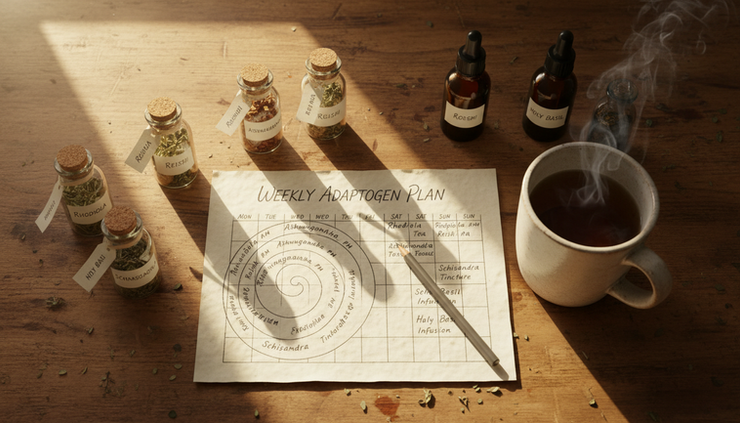
A few practical stack examples
These examples are general and conservative. They are meant to show structure, not tell anyone what to take.
The focused morning stack
This is for a person who feels mentally foggy in the morning but sleeps reasonably well.
Morning
Rhodiola
Optional later support
Holy basil tea in the afternoon
This keeps stimulation earlier and avoids mixing too many energizing herbs.
The evening wind-down stack
This is for a person who carries stress into the evening.
Early evening
Ashwagandha
Before bed
Reishi tea or powder
This stack should be watched for next-day grogginess. If the morning feels heavy, reduce the dose, change timing, or use only one.
The gentle daily balance stack
This is for a person who wants steady support without a strong push.
Daytime
Holy basil
Evening
Reishi
This is less stimulating than a rhodiola or cordyceps-based plan and may fit people who are sensitive to energizing herbs.
The high-demand season stack
This is for short periods of extra demand, such as travel, exams, caregiving, or a heavy work season.
Morning
Rhodiola or eleuthero
Afternoon
Schisandra or holy basil
Evening
Reishi
This type of stack should not become a way to ignore ongoing burnout. If the season never ends, the plan needs lifestyle changes more than herbs.
Signs your adaptogen stack may be too much
A stack that works should feel steady, not dramatic. Watch for these warning signs:
Sleep gets worse after adding daytime adaptogens
You feel wired, irritable, or unusually restless
You need more products to get the same effect
Digestion changes and stays off
You feel flat, dull, or overly sedated
You cannot tell what each herb is doing
You are taking several blends with overlapping ingredients
You keep using adaptogens to push through exhaustion
If any of these show up, simplify. Stop adding. Review labels. Consider pausing the whole stack and reintroducing one item at a time, with medical guidance when needed.
The best stack is usually the simplest one
Adaptogen stacking—particularly thoughtful combinations of Rhodiola and Ashwagandha—offers a compelling option for people seeking natural support for stress resilience, energy balance, sleep, and cognitive stamina. The complementary mechanisms provide a more rounded profile than single agents for many users, with a generally favorable short-term safety profile when quality products and moderate doses are used.
However, the risks of overuse are real: mild-to-moderate side effects or rare but serious events such as liver injury or hormonal disruption, potential drug interactions, tolerance, and the danger of masking deeper issues. Evidence for combinations is still emerging and largely inferred from individual studies. Individual variability is high.
The wisest path is informed, cautious, and personalized use—starting low and slow, cycling, prioritizing quality, consulting professionals, and never neglecting the fundamentals of healthy living. When approached this way, adaptogens can be a valuable part of a broader toolkit for navigating modern stress with greater ease and vitality. Always remember: this information is educational and not a substitute for personalized medical advice. Listen to your body, work with qualified practitioners, and build resilience from the ground up.
The most holistic approach is not the largest stack. It is the one that supports energy, calm, sleep, and recovery without asking herbs to do the work of rest, nourishment, and real life boundaries. Peace
All information provided on this website, including blog posts, articles, and any related content, is for general informational and educational purposes only. It is not intended to diagnose, treat, prescribe, cure, mitigate, or prevent any medical condition or disease. Always consult a qualified healthcare provider before making any changes to your health regimen, including the use of herbs, teas, foods, or supplements discussed here. The author is not a licensed medical professional, and this content does not replace professional medical advice, diagnosis, or treatment. The author and One Stop Apothecary are not responsible or liable for any adverse effects, consequences, or outcomes resulting from the application or use of any suggestions, preparations, or information presented herein. Any use of this material is at the reader's own discretion and sole responsibility. These statements have not been evaluated by the Food and Drug Administration (FDA). This information is not intended to diagnose, treat, cure, or prevent any disease.
References/Sources
Below is a compiled list of the primary sources drawn from the web searches that informed the original blog post. Each entry includes the title and a direct, actionable link. These correspond to the [web:#] results used for factual claims, clinical summaries, safety notes, stacking guidance, and evidence on Rhodiola, Ashwagandha, and related adaptogens.
Ashwagandha and Rhodiola Together: Physician's Dosing & Safety Guidehttps://empowervida.com/blog/ashwagandha-and-rhodiola-take-together-physician-guide/
Can You Take Rhodiola and Ashwagandha Together? (Healthline)https://www.healthline.com/health/rhodiola-and-ashwagandha-together
How do ashwagandha, rhodiola, and eleuthero compare? (Nutri Tailor)https://nutritailor.co.uk/apps/learn/how-do-the-main-adaptogens-compare-ashwagandha-rhodiola-and-eleuthero
Ashwagandha vs Rhodiola: Which Adaptogen for Your… (Optmzd)https://www.optmzd.app/blog/ashwagandha-vs-rhodiola
What Happens When You Take Ashwagandha and Rhodiola Together? (Verywell Health)https://www.verywellhealth.com/ashwagandha-and-rhodiola-11748648
Ashwagandha vs Rhodiola Rosea: Cortisol, Stress & Longevity (Ziv Health)https://zivhealth.com/longevity-wellness/compare/ashwagandha-vs-rhodiola-rosea-adaptogen-stress-cortisol/
Adaptogens Compared: Ashwagandha vs Rhodiola vs Holy Basil (HappierFit)https://happierfit.com/adaptogens-compared-ashwagandha-vs-rhodiola-vs-holy-basil/
How to take adaptogens | Ashwagandha, rhodiola & more (Holland & Barrett)https://www.hollandandbarrett.com/the-health-hub/conditions/brain-health/can-you-combine-adaptogens-and-why-would-you-want-to/
How to Cycle Adaptogens: The 8-Week Protocol (2026)https://thebodyblueprint.com/how-to-cycle-adaptogens-8-week-protocol/
Adaptogens in Fitness: Ashwagandha, Rhodiola, Cordyceps, and Ginseng (Los Angeles Times)https://www.latimes.com/fitness/workouts/story/adaptogens-ashwagandha-rhodiola-cordyceps-ginseng
Adaptogens for Stress: Ashwagandha, Rhodiola and Beyondhttps://drcolinmacleod.com/articles/adaptogens-for-stress-ashwagandha-rhodiola-and-beyond/
Ashwagandha vs Rhodiola: Top Picks Rankedhttps://bodysciencereview.com/blog/ashwagandha-vs-rhodiola/
Rhodiola | Memorial Sloan Kettering Cancer Centerhttps://www.mskcc.org/cancer-care/integrative-medicine/herbs/rhodiola
The Effectiveness of Rhodiola rosea L. Preparations… (PMC)https://pmc.ncbi.nlm.nih.gov/articles/PMC9228580
Rhodiola - Merck Manualhttps://www.merckmanuals.com/home/special-subjects/dietary-supplements-and-vitamins/rhodiola
Ashwagandha: Usefulness and Safety | NCCIHhttps://www.nccih.nih.gov/health/ashwagandha
Ashwagandha | Memorial Sloan Kettering Cancer Centerhttps://www.mskcc.org/cancer-care/integrative-medicine/herbs/ashwagandha
What Are Adaptogens? Exploring the Types and Benefits (GoodRx)https://www.goodrx.com/well-being/supplements-herbs/adaptogens
What Are Adaptogens? Benefits & Risks – Forbes Healthhttps://www.forbes.com/health/supplements/what-are-adaptogens/
List of Adaptogens: Best Herbs & Mushrooms… (Mind Lab Pro)https://www.mindlabpro.com/blogs/nootropics/list-of-adaptogens
Plant Adaptogens—History and Future Perspectives (PMC)https://pmc.ncbi.nlm.nih.gov/articles/PMC8398443
Effects of multi-herb and ashwagandha root formulas on stress modulation… (PubMed)https://pubmed.ncbi.nlm.nih.gov/41656269/
State-of-the-Art Review on Botanical Hybrid Preparations… (MDPI / PubMed)https://pubmed.ncbi.nlm.nih.gov/38675443/(Full text also available via related MDPI link in search results)
Safety Considerations for Natural Products with Adaptogenic… (PMC)https://pmc.ncbi.nlm.nih.gov/articles/PMC12389708/
These sources provided the clinical trial summaries, safety data, stacking rationale, mechanism comparisons, dosing notes, and risk discussions used throughout the original blog. Additional supporting results from the same search batches (e.g., Examine.com-style comparisons, individual herb reviews, and interaction notes) were cross-referenced for balance but are represented by the core links above.
Returning to traditional-style preparations (teas, milk tonics, moderate whole-herb use)
Rhodiola Rosea: Discover the Traditions of Rhodiola – Mother Earth Livinghttps://www.motherearthliving.com/health-and-wellness/Herbs-for-Health-Finding-a-new-friend-in-an-old-herb-Rhodiola-rosea-Rhodiola-rosea-Traditions/
Rosenroot (Rhodiola rosea): Traditional use, chemical composition, pharmacology and clinical efficacy – ScienceDirecthttps://www.sciencedirect.com/science/article/abs/pii/S094471131000036X
Rhodiola Rosea In Traditional Medicine – rhodiolarosea.orghttps://rhodiolarosea.org/rhodiola-rosea-in-traditional-medicine/
Traditional Rhodiola Energy Elixir Recipe Guide – Herboryahttps://www.herborya.com/rhodiola-energy-elixir/
Rhodiola (Rhodiola rosea): Benefits, Uses, Safety | Herbal Realityhttps://www.herbalreality.com/herb/rhodiola/
Ashwagandha: The Classical Ayurvedic Guide to Withania… – Art of Vedashttps://artofvedas.in/pages/ashwagandha-ayurvedic-guide
Withania somnifera (L.) Dunal – Modern perspectives of an ancient Rasayana from Ayurveda – ScienceDirecthttps://www.sciencedirect.com/science/article/abs/pii/S0378874120330397
Ashwagandha Uses and Plant Profile – Learning Herbshttps://www.learningherbs.com/blog/ashwagandha-uses
Ashwagandha Benefits: What Classical Ayurveda Actually Says – Art of Vedashttps://artofvedas.com/pages/ashwagandha-benefits-classical-guide
Ashwagandha Tea Ayurvedic Guide… – Ayurveda Institute UKhttps://ayurvedainstitute.co.uk/ashwagandha-tea-ayurvedic-guide-to-stress-relief-sleep-and-vitality/
Holy Basil’s Rich History… – HerbalGram / American Botanical Councilhttps://www.herbalgram.org/resources/herbclip/issues/2025/issue-755/holy-basil-history-health-benefits-functional-food/
What to Make With Holy Basil? – Hungry in Thailandhttps://hungryinthailand.com/holy-basil/
Holy Basil: The Zen Herb – Mother Earth Gardenerhttps://www.motherearthgardener.com/plant-profiles/holy-basil-plant-zm0z17szfis/
Tulsi Monograph — HerbRallyhttps://www.herbrally.com/monographs/tulsi-rh
Schisandra – HerbalGramhttps://www.herbalgram.org/resources/herbalgram/issues/106/table-of-contents/hg106-herbpro-schisandra/
Pharmacology of Schisandra chinensis Bail.… – ResearchGatehttps://www.researchgate.net/publication/5336030_Pharmacology_of_Schisandra_chinensis_Bail_An_overview_of_Russian_research_and_uses_in_medicine
Traditional and Modern Medicinal Uses of Cordyceps… – ResearchGatehttps://www.researchgate.net/publication/393378615_Traditional_and_Modern_Medicinal_Uses_of_Cordyceps_Cordyceps_and_Allied_Species
A preliminary review of studies on adaptogens… – PMChttps://pmc.ncbi.nlm.nih.gov/articles/PMC6240259/
What is an Herbal Tea Decoction… – Wholeistic Livinghttps://wholeisticliving.com/2023/02/10/herbal-tea-decoction/
Ashwagandha vs Rhodiola: Preparation… – Herbal Goodness Co.https://www.herbalgoodnessco.com/blogs/healthy-living/ashwagandha-vs-rhodiola-preparation-flavor-daily-use-guide
These sources document the historical, ethnobotanical, and classical textual records used above. Traditional practice prioritized context, preparation method, and individual constitution—principles that remain relevant when considering modern stacking.



Comments