
Fall Apothecary Reset
The first cool week of fall has a way of exposing the truth about your home apothecary. The elderberries are hiding behind the grill rub. The nettles smell like last spring. The zinc lozenges are somehow open, sticky, and expired. Meanwhile, school germs are circulating, ragweed is floating around, and the sun is vanishing before dinner.
This is the perfect time to reset your apothecary, but not by buying a cart full of trending immune stacks for fall. Most of the time, the better move is quieter: open the cabinet, pull everything out, and sort what you already have.
A good fall reset helps you see what’s still useful, what needs to go, and what belongs closer to the kettle for the new season. It also helps you avoid doubling up on herbs, supplements, or remedies that don’t generally have a role for the fall season.
Edit the summer apothecary for fall.
Reorganize the jars you already have for ragweed, first-aid, and short colds, instead of adding trending immune stacks. Early fall has a short list of jobs; Ragweed, Scrapes and bites from being outside, the first classroom cold, drier indoor air, and a schedule that just changed. That list does not require a new “immunity” product. It requires the plants you already researched this year, sorted by use, labeled properly, ready for you to use.
This post is informational only and isn’t medical advice. Herbs and supplements can affect medications, allergies, pregnancy, children, surgery, and chronic conditions. When in doubt, ask a qualified herbalist, clinician or pharmacist.
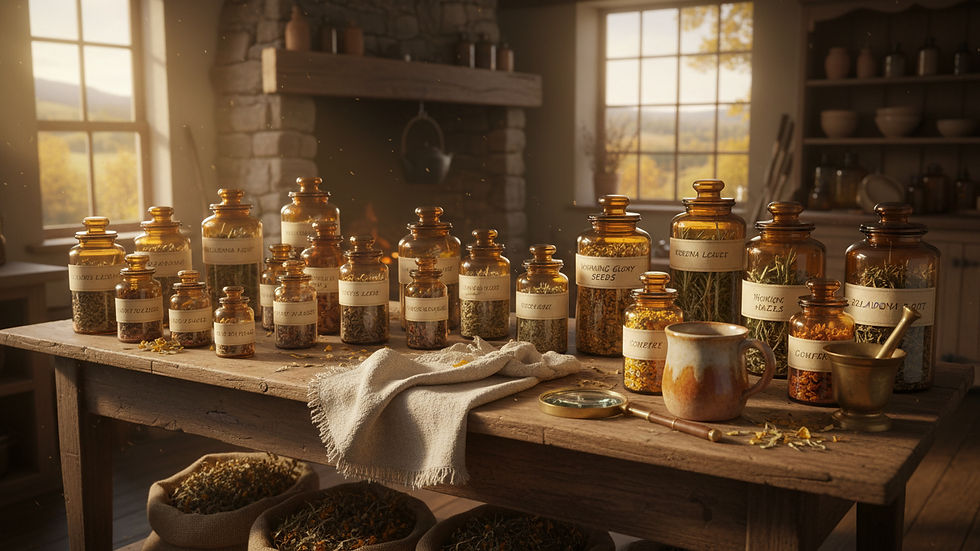
Start with the season you’re actually in
Summer apothecaries tend to be bright and ready for sudden/acute responses. Think peppermint after too much sun, jewelweed for poison ivy, calendula oil for skin, lemon balm iced tea, a plantain bug bite balm, marshmallow root cold infusions, and that one jar of hibiscus you swore you’d drink every afternoon.
Fall asks for something different.
Not because the body magically needs a new cabinet on September 1, but because daily life changes. Kids go back to school. Indoor time increases. Ragweed pollen rises in many parts of the United States in late summer and early fall. Days get shorter, which can mess with energy, mood, routines, and sleep timing. Heating systems start drying out the air. Soup sounds good again.
So before you add anything, determine the real fall issues in your house.
Maybe they look like this:
School and daycare sniffles
Ragweed symptoms that make your eyes itch and your throat feel scratchy
Less daylight, which nudges bedtime later even though mornings start earlier
Dry indoor air that leaves your throat and skin cranky
Heavier schedules, fewer slow afternoons, and more convenience food
A nervous system that feels louder after the loose rhythm of summer
That list is more helpful than a shopping list because it tells you what your home apothecary will need to do.
Your apothecary for fall can be pretty simple. You might need a respiratory corner, a sleep and stress corner, a cold and flu spot, a digestion corner, and a “use this soon” basket. That’s plenty. A shelf that makes sense on a tired Tuesday night beats a packed cabinet that only looks good in a photo.
Let your fall needs shape the sort
Pull out the jars, bottles, tins, tea boxes, tinctures, syrups, lozenges, oils, and capsules. Put them where you can see them all. A kitchen table works well.
Then sort by use, not by aesthetic or the latest trend.
A few practical piles:
Daily drinks
Teas and infusions you’ll actually make on a weekday.
Scratchy throat and dry air
Demulcent herbs, honey, lozenges, saline supplies, and soothing teas.
Seasonal colds or flu
The right herbs for the first 24–72 hours of a cold.
One named echinacea product. One cooked-ripe elderberry product. Start at onset, clear durations. Concentrated daily syrup for weeks is a sugar habit with a plant in it.
Seasonal allergy support
Items you reach for when pollen is high, plus any over-the-counter medications you use.
hay fever weeks. Nettle leaf (Urtica dioica). Infusion. Leaf only.
Sleep and evening wind-down
Chamomile, lemon balm, magnesium, bath herbs, or whatever safely fits your routine.
Digestion and heavier meals
Ginger, peppermint, fennel, bitters, or simple tea blends.
Skin and body care
Balms, oils, salves, bath salts, and anything left from summer.
skin and first-aid. Plantain (Plantago major or P. lanceolata). Fresh poultice or salve. Calendula oil or salve stays here
Question marks
Anything unlabeled, oddly colored, old, sticky, dust-covered, or forgotten.
The “question marks” pile matters. That’s where you’ll find the bottle you bought after reading one passionate comment thread, the mystery tincture with no date, and the jar of dried flowers that has lost all scent.
Do the shelf audit before you make a shopping list
There’s a very satisfying kind of apothecary cleaning where you don’t buy a single thing. You just make what you have organized and easier to find.
Start with labels. Every jar, bottle, box and tin should have at least three things:
Common name
Date purchased, harvested, or opened
Form or preparation, if it’s not obvious
Even better, add the Latin name when you know it. That matters because common names can get messy. “Chamomile” might mean German chamomile or Roman chamomile. “Cinnamon” can mean different species with different coumarin levels. Echinacea can be E. angustifolia, E. pallida or E. purpurea, they are not the same. You don’t need to turn your kitchen into a lab, but a little precision helps.
If you make your own tinctures, oils, vinegars, or syrups, label them with:
Herb
Alcohol percentage, oil, vinegar, honey, or glycerin base
Start date
Bottle date
Any safety note you already know, like “avoid with ragweed allergy” or “not for children under 1 because of honey”
That last example is basic but important. The American Academy of Pediatrics and the CDC advise against giving honey to babies under 12 months because of the risk of infant botulism. A simple label can prevent a tired mistake.
Use your senses, but don’t gamble
Dried herbs don’t usually “expire” like milk, but they do lose color, scent, and strength over time. Oils can go rancid. Syrups can ferment or mold. Tinctures tend to last longer because alcohol preserves them, but labels with bottling dates still matter.
Check each item for:
What you’re checking | What to look for | What to do |
Color | Faded herbs, browned leaves, dull flowers | Move to “use soon” or compost if lifeless |
Smell | Weak scent, mustiness, sourness, rancid oil smell | Toss if musty, sour, or rancid |
Texture | Clumping, dampness, stickiness, crystallized syrup | Toss if moisture or mold is present |
Label | Missing name or date | Keep only if you are completely sure what it is |
Container | Loose lids, rusty caps, cracked jars | Repackage safe items in clean containers. Discard anything questionable |
Storage spot | Heat, sunlight, steam, bathroom humidity | Move to a cool, dark, dry place |
A good rule: if you can’t identify it with confidence, don’t use it. Composting the contents of a mystery jar is cheaper and safer than wondering whether you just brewed the wrong plant. The first fall task is subtraction. Clear expired syrups, mystery blends, and jars with no job before you add another trending immune stack.
Opened syrups past their date. Oils that smell like crayons or old nuts. Tinctures with no species on the label. Seven-herb “school immunity” blends. Anything you have not touched since last winter and cannot describe. Do not replace this week. An empty space is information. It means you do not currently have a tool for that job, or it means the job does not need the tool you had. Either way, do not shop to fill the gaps on August 31.While the jars are out on the kitchen table, wipe the shelves in the cabinet. Dust and debris do not have a place where you store or prepare medicine.
Make a use soon basket
Some herbs aren’t bad, they’re just fading. Those belong in a “use soon” basket. Don’t tuck them back into the cabinet and expect yourself to remember.
Good “use soon” projects for fall:
Add dried mint to after-dinner tea
Blend older chamomile with fresher lemon balm
Use nettle in mineral-rich infusions if it still smells green and grassy
Turn good but fading culinary herbs into soup blends
Add calendula petals to tea, bath or a foot soak blends
Use older cinnamon sticks for simmer pots, not internal remedies, if the scent is weak
This is where the reset starts to have value. You’re not wasting herbs you didn’t use. You’re giving those herbs a new job.

Keep the fall shelf purposeful and specific
The internet loves complicated fall protocols. Your real life probably doesn’t.
Most fall apothecaries work better when they’re built around a few steady categories. Think in terms of situations, the common seasonal issues, not more products.
Late August is when the household apothecary should start to change. The counter still looks like summer: cooling teas, leftover bug-bite salves, a half-used “immunity” bottle from last February, a blend you cannot name, and a syrup whose label peeled off. Then school starts, ragweed starts, the first cold comes home with your kid, and the reflex is to buy more. More is usually the wrong move. Your home apothecary probably doesn't need a larger shelf. It needs a purposeful one.
The ailments that actually show up in the next six weeks are specific: hay fever, scrapes and bites, the first short viral colds, drier indoor air, and a schedule that just got tighter. Those jobs can be covered with plants and preparations you already know and probably have— you move out what no longer earns space and stop treating colds all season long with “immune support” stacks or blends.
Plan for what fall actually brings, not marketing categories.
Hay fever and late-summer weed pollens. In much of North America, ragweed is already releasing pollen by the last week of August. That is itchy eyes, drippy nose, scratchy throat, and poor sleep from breathing through a mouth. It is a mucous-membrane and histamine problem. It is not proof that the house needs a daily antiviral 'immunity stack'. Nettle is the herb most households skip because they reach for “immune” herbs instead. Nettle leaf (Urtica dioica) is the straightforward kitchen plant for a histaminic, mineral-poor, scratchy throat week. The useful preparation is a strong infusion, not a capsule you swallow on the way out the door
Minor traumas from still being outside. Scrapes, splinters, mosquito bites, poison-ivy, cracked heels starting to feel the first dry indoor heat. Treat the irritated skin with your oils, ointments or salves. Not an ingestible beauty stack.
The first wave of school-year colds. Rhinovirus and the other common upper-respiratory viruses do not wait for January. They show up in classrooms, buses, and offices in September. The useful herbal question is what you do in the first two or three days — not what you swallow every morning until Thanksgiving so nobody “gets it.”
Drier air and irritated airways. Heat kicks on. Windows close. Throats get raspy. This is humidity, hydration, and simple demulcents are needed. It is not time for a lung-detox kit.
Schedule change that hit digestion and sleep. Bedtimes slide. Lunches get worse. People eat in the car. That is ordinary physiology under stress, not a reason to open five new bottles.
If a product on your shelf cannot be pointed at one of those jobs — with a plant name, a plant part, a preparation, and a stopping point — it is clutter.
Why your inventory grows in September
Immune stacks sell in back-to-school season because fear is easy to merchandise. The pitch is always the same: stay on the same product so the house stays well. Echinacea becomes breakfast. Elderberry becomes a lunchbox habit. A mushroom blend, a colostrum powder, a sea-moss gel, and a vitamin pile join them. By week two of school the counter looks pharmacy clearance sale.
Two separate mistakes get put together. The first is using acute plants as tonics. Echinacea and elderberry have real, specific, purposeful uses at the onset of a cold. They do not have strong evidence as all-autumn preventives, and using them for months ignores how they were studied and traditionally used: short and early. Prolonged use can diminish effectiveness and alter the natural immune response.
The second is buying a category instead of assigning a job. “Immune” is not a job. Preventing every virus in a building is not a job an herb can handle. Soothing a hay-fever week, cleaning a scrape, or shortening of a cold are the real jobs. Clearing the shelf is how you separate those. Do the clear-out before you reorganize. Take everything off the shelf. All of it. If you only slide bottles around, you will keep the same mess in a new order. Make specific groups. Keep the ones for a known fall job. Keep herbs with a purpose. If you know what the plant is for, the part does, what you will make or take, and when you will stop, Keep it.
The fall jobs for your apothecary
Job 1: Nettle for ragweed and irritated hay-fever weeks
Ragweed is wind-pollinated. It is already moving in much of North America by late August. That is a mucous-membrane and histamine-load problem. It is not a reason to start a daily antiviral stack.
Nettle leaf is the plant already on this shelf for that job. Use dried leaf. Root is for a different indication. Do not buy nettle root because the leaf tin is low.
What the leaf is here for: a strong water extract when pollen is actually high. Freeze-dried leaf has one often-cited older trial in allergic rhinitis. Treat that as modest, time-limited support. It is not an antihistamine drug and it is not a season long allergy-cure protocol.
Preparation that matches the job:
30 g (1 oz) dried Urtica dioica leaf
1 quart (950 mL) water just off the boil
Covered jar or pot
Steep 4–8 hours, or overnight
Strain. Refrigerate. Use within 48–72 hours
An adult working amount in a high-pollen stretch is 1–2 cups from that quart in a day, not the whole quart as a test. For a single cup, 1–2 teaspoons dried leaf per 8 oz water, covered 10–15 minutes.
Specific for this job:
Fresh plant stings. Dry it or cook it.
Diuretic. Do not drink a daily quart next to blood-pressure drugs or prescription diuretics without the clinician who already knows the case.
Blood-sugar and anticoagulant medicines: same rule.
Kidney disease: not a home protocol.
Pregnancy: ordinary culinary tea is not a daily quart.
Stop or scale down when the pollen pulse drops. Nettle leaf is not a new fall protocol.
What does not go on this row: “allergy detox” teas, lymphatic purge drinks, goldenrod as a campaign (that plant has its own purpose), or a blend that also claims to prevent colds.
Job 2: first-aid and late-summer skin
Being outdoors in August and September produce bites, scrapes, splinters, and irritated patches. That is mechanical and local. It is not immunity.
Plantain is the plant already researched for this row. Identify Plantago major (broadleaf) or P. lanceolata (ribwort). Harvest from unsprayed ground, or use dried leaf you trust. Mucilage and aucubin are the usual chemistry notes. The use is drawing and soothing on minor, intact skin — and a mild tea for scraped mouth or irritated gut lining. Keep those two uses separate. External, primary:
Wash fresh leaf
Crush until wet paste is formed
Wrap in clean gauze for a compress
Apply 10–20 minutes
Repeat a few times in a day if the skin still qualifies as home care
Throw the leaf away. Do not reuse it
If you are not picking it from your yard, use a dried-leaf, infused oil or the salve you already made. That stays external.
Internal:
1 teaspoon dried leaf per 8 oz water
Covered 10–15 minutes
Occasional cup
Calendula (Calendula officinalis) just had its week. Do not write another monograph. If the dried flower heads, oil or salve from that week are clean and dated, park it on this same row for minor irritated skin. Asteraceae allergy still applies. Patch-test. It is not a parasite kit and it is not a regenerative-skin stack.
Limits for this row:
Dirty or misidentified herb is not medicine
Spreading redness, fever with a bite, puncture wounds, or anything that needs stitches: clinic
Rare allergy to plantain
Do not swallow first-aid oil
Do not turn plantain into a daily “barrier” capsule for school germs
Job 3: the first days of a cold — then stop
Back-to-school colds start now. That is true. The error is treating that fact as a subscription for a season long protocol. Echinacea and elderberry are used at the onset of a cold. They do not move to the breakfast mug from Labor Day to Thanksgiving. What's important is duration and part, not a relaunch of a season long protocol.
Echinacea purpurea, E. angustifolia, and E. pallida are not one product. Plains nations used root and aerial parts for wounds, bites, and acute febrile illness. Alkylamides (root, tongue tingle), caffeic acid derivatives, and polysaccharides in some aerial and expressed-juice products are why papers talk about innate-immune signaling. That chemistry does not authorize a quarter-long course.
Taken together, cold and upper-respiratory trials point to a modest effect on duration or severity when a specific preparation starts early. Prevention data is inconsistent. That matches short traditional use better than it matches a school-year bottle.
Adult use, first 24 hours of symptoms, not before:
Dried aerial E. purpurea: 1–2 g, covered infusion, up to three times a day
Tincture: only with species and part on the label. A common range for a 1:5-class extract is 2.5–5 mL two or three times a day. Do not invent a dropperful for an unlabeled blend
Course: 7–10 days. Write the stop date when you start
Children: only a product that states a pediatric dose, and only for a short course. “The classroom is sick” is not a dose
Do not use if there is an Asteraceae allergy. Do not self-prescribe a daily immunostimulant in autoimmune disease. Do not add it on top of immunosuppressants or a clinician-managed immune condition. It does not treat pneumonia, an asthma flare, or a child who is not drinking. Unlabeled “coneflower blend” goes in the discard pile. Do not replace it this week unless someone is actually getting sick and you need one named product for a dated course.
Elderberry — ripe, cooked, short duration use. American elder is Sambucus canadensis (often filed as S. nigra subsp. canadensis). Ripe cooked berry and flower are the parts used. Leaves, stems, and unripe fruit contain cyanogenic glycosides. Raw blender shots are a toxicity problem, not folk practice.
A few small trials on standardized syrups found a shorter symptom length when dosing started at the front of influenza-like symptoms. That is purposeful herbal use. It is not a lunchbox syrup taken everyday until Thanksgiving. Adult use during the viral week only:
Labeled syrup: follow the stated elderberry amount for 3–5 days. Many adult labels land near 1 tablespoon, two to four times a day. That number does not transfer to an unmeasured homemade pot
Homemade: ripe berries only, cooked, with fruit weight and finished volume written down
Dried flower tea: 1–2 g per cup, covered 10 minutes. Flower is not berry- they actually have different uses.
You may have other jobs and other herbs that are important for your apothecary, this is by no means a complete list. Just keep the jobs and the real issues in mind.
Reorganizing with a purpose
The school cold and indoor air shelf
School brings routines, backpacks, lunch boxes, late nights, and shared, furnace heated indoor air. No immunity stack replaces the boring basics here.
The usual respiratory virus prevention advice stays useful because it’s simple and proven: wash hands, improve ventilation when you can, stay home when sick, and cover coughs and sneezes. Sleep, clean nutrition, hydration, and stress also shape how well people handle the season.
Your apothecary can support the routine around those basics.
Good shelf items might include:
A pleasant evening tea that helps everyone slow down
Honey for adults and children over 1 year old
Ginger for tea when digestion feels off
A thermometer with working batteries
Saline spray or rinse supplies
Tissues, lip balm, and a clean humidifier plan
Broth herbs like thyme, sage, bay, and garlic
That last one counts. Culinary herbs are part of nutritional herbology and the home apothecary. Thyme in soup, ginger in tea, garlic in dinner, and sage in broth are all practical fall supports. They also get used, which is more than we can say for many expensive capsules.
The ragweed reality shelf
Ragweed season can be rough. In the United States, ragweed pollen often peaks from late summer into fall, though timing varies by region and weather. Windy, dry days can make symptoms worse. Rain can temporarily lower pollen, then plant growth can rebound.
This matters because a few popular herbs sit in the same plant family as ragweed, the Asteraceae family. That family includes chamomile, echinacea, calendula, yarrow, and dandelion.
Does that mean everyone with ragweed allergies must avoid all of them? No. People react differently. But if ragweed makes you miserable, pay attention. The National Center for Complementary and Integrative Health notes that echinacea can cause allergic reactions, especially in people allergic to related plants such as ragweed, mums, marigolds, or daisies.
That’s a good reason to stop treating echinacea as a casual “just in case” herb.
If you know you react to ragweed or other Asteraceae plants, move related herbs into a clearly labeled section. If you’ve had strong allergic reactions, talk with a clinician before using them. Don’t experiment during a pollen flare when your immune system is already annoyed.
You can also support ragweed season with non-herbal basics:
Check local pollen counts
Rinse hair or shower after heavy outdoor exposure
Change pillowcases often during high pollen weeks
Keep windows closed on high pollen days if that helps your symptoms
Use an air purifier if you already have one and maintain the filter
Follow your clinician’s plan for antihistamines, nasal sprays, or inhalers
The fall apothecary shouldn’t compete with medical care. It should make your home routine easier.
The shorter days shelf
Shorter days can affect sleep and mood. Light exposure helps regulate circadian rhythm, the body’s internal clock. Morning light is especially useful because it signals daytime to the brain. Evening darkness helps the body wind down.
Herbs can be part of a sleep routine, but the routine matters more than the jar.
If the evenings feel jagged, build a small shelf around a repeatable cue:
A caffeine cutoff that actually fits your life
A warm drink after dinner
Dimmer lights during the last hour of the day
A book, bath, or low-key task instead of endless scrolling
A consistent wake time when possible
Morning outdoor light, even for a few minutes
Common evening herbs include chamomile, lemon balm, passionflower, skullcap, lavender, and oatstraw. They aren’t all right for everyone. Some can interact with sedatives, antidepressants, thyroid medications, alcohol, or pregnancy. Some aren’t ideal before driving or operating equipment. Keep the shelf simple and know your own limits and contraindications.
If you already have three sleep blends, test one at a time. Don’t stack every calming herb you own because you had a stressful Tuesday. That makes it harder to know what helped and what left you groggy.

Rework summer herbs into fall-friendly habits
A fall reset gets more fun when you stop seeing summer leftovers as clutter. Many of them can shift into cooler-weather routines with slightly different jobs.
Peppermint can move from iced tea to after-dinner tea
Peppermint feels summery when it’s cold with lemon. In fall, it becomes a warm soothing after-dinner tea. It pairs well with fennel, ginger, cacao nibs, or a little licorice root if licorice is safe for you.
A safety note: peppermint can worsen reflux for some people. If minty tea makes heartburn louder, don’t force it.
Lemon balm can become an afternoon pause
If you grew or bought lemon balm for summer iced tea, try it warm in the afternoon. It has a soft lemony taste, and many people use it as a gentle calming tea.
Be thoughtful if you take thyroid medication or sedating medications, or if you’re pregnant or nursing. Ask a clinician if you’re unsure.
Hibiscus can brighten dark evenings
Hibiscus doesn’t need to retire with summer. It makes a tart, ruby tea that works hot with orange peel, cinnamon, clove, or ginger. It’s also lovely blended with rosehips.
Hibiscus may affect blood pressure or interact with some medications, so use common sense and get advice if that applies.
Calendula can leave the tea shelf and move to skin care
Calendula often gets collected in summer. In fall, it can support skin routines as the air gets dry. If you already have calendula-infused oil, check it for rancidity. If it smells like old crayons, toss it.
If you have dried calendula that still looks bright, use it in:
Bath tea
Foot soaks
Homemade salve, if you know safe oil handling
A gentle infused oil for external use
Avoid calendula if you know you react to Asteraceae plants.
Marshmallow root can help with dry-season comfort
Marshmallow root is rich in mucilage, which gives it that slippery texture people use for dry throat comfort. It’s often prepared as a cold infusion because hot water can make it starchier and less pleasant.
Because it can coat the digestive tract, it may affect absorption of medications. Separate it from medications by a few hours unless your clinician says otherwise.
Culinary herbs can earn front-row status
Don’t overlook the spice drawer. Fall cooking is daily medicine in the traditional sense of care, comfort, and nourishment.
Useful fall kitchen herbs and spices include:
Ginger
Thyme
Sage
Rosemary
Garlic
Cinnamon
Cardamom
Fennel
Black pepper
Bay leaf
These don’t need dramatic claims. Thyme in bean soup, ginger in tea, cinnamon in oats, and fennel after a heavy meal are practical uses. They make fall routines easier to keep.
Edit out what doesn’t belong
This is the part where the reset pays off.
A crowded shelf can make you use things carelessly. It can also make you forget the remedies that actually help. Editing is a form of safety.
Remove duplicate blends
If you have four “immune” teas, compare the ingredient lists. You’ll probably see the same herbs repeated: echinacea, elderberry, ginger, licorice, rosehips, cinnamon, orange peel, astragalus, reishi, and so on.
Duplicates formulas increase the chance that you’ll over medicate with an ingredient without noticing. Licorice root, for example, can raise blood pressure and lower potassium in some people and isn’t a casual daily herb for everyone. Cinnamon varies by type and amount. Elderberry products vary in quality and preparation. Mushrooms can interact with medications or immune conditions. Echinacea purpurea, E. angustifolia, and E. pallida are not the same product
Pick one blend you like that lists herbs with your purpose in mind. Move the rest to the “use soon” group, or let them go if they’re old.
Retire the panic purchases
Every apothecary has them.
The tincture you bought during a stressful week. The powder you tried once and hated. The supplement bottle with a promise that never happened. The superfood blend that tastes like sweetened dirt.
If you don’t know why it’s there, don’t keep it in the main shelf.
Create a small “research before using” bin if you truly want to learn about an item. Put a date on the bin. If you haven’t looked it up or asked a clinician within a month, that’s your answer. Compost it
Watch for overlap with medications
This is where fall enthusiasm can get risky. Supplements and herbs can affect blood thinners, blood pressure medications, diabetes medications, antidepressants, sedatives, seizure medications, immune-suppressing drugs, and more.
A few common examples:
St. John’s wort interacts with many medications and can reduce the effectiveness of some.
Licorice root can affect blood pressure and potassium.
Ginkgo, garlic supplements, and high-dose ginger may matter for people on blood thinners or before surgery.
Sedating herbs can add to the effects of alcohol, sleep aids, or anxiety medications.
Some immune-stimulating herbs may not be appropriate for autoimmune conditions or transplant medications.
You don’t need to memorize every interaction. Keep a simple rule: if you take regular medication, ask a herbalist, pharmacist or clinician before adding internal herbs or supplements. Bring the bottle or a photo of the label. That makes the conversation much easier.
Keep children’s remedies separate
Adults and children don’t always use the same doses, herbs, or products. Keep kids’ items in their own labeled area, especially if you have tinctures, essential oils, capsules, or strong herbs in the house.
A few basics:
Don’t give honey to babies under 12 months.
Be cautious with essential oils around children and pets.
Avoid adult tincture dosing for kids unless guided by a qualified professional.
Keep all supplements out of reach, even the “natural” ones.
Use a real measuring spoon or syringe, not a kitchen spoon, for liquid products.
Natural doesn’t mean harmless. It means “from nature,” and nature makes plenty of strong things.

Build simple fall apothecary routines
After all the sorting, tossing, and labeling, you need routines with purpose to survive real life.
Here’s a simple weekly rhythm that works for a lot of households.
Sunday, take ten minutes to plan your week
Refill the tea blend area. Put one or two teas where you’ll see them. Wash the tea strainer. Check honey, lemons, ginger, tissues, and saline supplies. Move any “use soon” herb into the front row.
If you prep food, add nutritional herbology and traditional apothecary thinking there too. Will I make broth? How about soups?. What herbs will fortify them? Put cinnamon near the oats. Purposeful moves are what counts.
Weeknight calming habits
Pick default evening drinks with a purpose.
Examples:
Chamomile and lemon balm
Ginger and fennel
Peppermint
Hibiscus, rosehips, and orange peel
Oatstraw and cinnamon
Keep these for their specific purpose.
Pollen days get a plan
When ragweed is high, don’t start three new herbs. Stick with known supports and reduce exposure where you can. If you use allergy medication, follow the label or your clinician’s instructions. If symptoms are severe, wheezy, or unusual, get medical advice.
Your apothecary's job on pollen days is support, comfort and consistency, not heroics.
Sick days get purposeful herbal support
When someone wakes up with a sore throat or fever, cold or flu, decision-making requires a purpose.
Purposeful support looks like:
Take temperature
Start fluids
Use saline spray or rinse if appropriate
Make the correct herbal tea with honey for ages 1 and up
Start the syrup and tincture schedule and choose a planned end date
Rest
Check medication labels for dosing
Watch for warning signs
Call clinician if symptoms are severe, prolonged, or get concerning
Put the pretty jars where they work
A beautiful apothecary that’s hard to use becomes decor. That’s fine if decor is the goal, but a real home apothecary is for purpose and function.
Store daily items where you make tea. Store strong tinctures and supplements away from kids. Store oils away from heat. Store bulk herbs in a cool, dark, dry place. Keep duplicates behind the active jar so you finish one before opening another.
A practical fall reset checklist
Use this when you don’t want to overthink it.
Pull everything out.
Wipe the shelf.
Compost or toss anything moldy, musty, rancid, damp, unlabeled, or unknown.
Check dates and quality.
Make a “use soon” basket.
Group items by fall use.
Label jars clearly.
Separate children’s items.
Flag herbs that may interact with medications or allergies.
Store herbs away from heat, light, and moisture.
Dot shop until you’ve removed all the noise.
That last step might be the hardest one.
A reset can make you realize you already have enough. Maybe more than enough. Enough teas to soften the evening. Enough ginger for three rounds of soup. Enough honey for scratchy throats. Enough calendula for a month of dry hands. Enough information to be safer than you were last season.
Fall issue | What you actually use | What you do not do |
Ragweed, itchy eyes, drippy nose | Nettle leaf infusion, days when pollen is high | Daily echinacea “for allergies” |
Mosquito bite, scrape, splinter | Plantain poultice or salve; calendula salve if you have it | Internal “skin immunity” capsules |
Day 1 of a cold | Named echinacea, 7–10 days | Open every bottle on the counter |
Day 1 of a flu-like week | Cooked elderberry, 3–5 days | Preventive syrup everyday until winter starts |
Dry hands from indoor heat | Oil or salve you already made | Ingestible beauty stack |
“The whole class is sick” and nobody at home is sick | Sleep, food, proper rest | A new mega immunity stack |
The goal is not a perfect shelf. It’s a shelf where you can find everything when you’re tired. A shelf with herbs for a purpose.

Use what's on the shelf before you add to it
Before you buy anything new, spend a week or two using what you just organized. Notice what you reach for. Notice what you avoid. Notice which tea actually gets made.
If you still see a true gap after that, buy one thing with a purpose. Not a stack. Not a panic bundle buy. Not the latest hyped up trend. One useful item that fits your purpose, your life, your body, and your needs.
Fall already brings plenty of noise: school schedules, pollen counts, early sunsets, crowded calendars, and sniffles that arrive at the least convenient time. Your apothecary doesn’t need to add more noise.
Let it become a small, steady, purposeful place. Clear labels. Purpose chosen herbs and blends or formulas. A few trusted remedies. A herb that gets used is far better than the super blend you never touch.
That’s a reset worth doing. Peace
All information provided on this website, including blog posts, articles, and any related content, is for general informational and educational purposes only. It is not intended to diagnose, treat, prescribe, cure, mitigate, or prevent any medical condition or disease. Always consult a qualified healthcare provider before making any changes to your health regimen, including the use of herbs, teas, foods, or supplements discussed here. The author is not a licensed medical professional, and this content does not replace professional medical advice, diagnosis, or treatment. The author and One Stop Apothecary are not responsible or liable for any adverse effects, consequences, or outcomes resulting from the application or use of any suggestions, preparations, or information presented herein. Any use of this material is at the reader's own discretion and sole responsibility. These statements have not been evaluated by the Food and Drug Administration (FDA). This information is not intended to diagnose, treat, cure, or prevent any disease.
The Aug 31 blog was written from synthesized herbal and clinical knowledge. These are the published sources that correspond to its specific claims.
Season and fall jobs
Allergy & Asthma Network. Ragweed Allergies. Ragweed typically starts in early August, peaks mid-September.
https://allergyasthmanetwork.org/allergies/pollen-allergy/ragweed-allergy/
AAAAI National Allergy Bureau. Pollen counting network for local ragweed and other pollens.
Nettle leaf (Urtica dioica)
Mittman P. Randomized, double-blind study of freeze-dried Urtica dioica in the treatment of allergic rhinitis. Planta Med. 1990;56(1):44–47.
Memorial Sloan Kettering Cancer Center. Nettle. Uses, limited allergy data, root vs other indications, interactions.
https://www.mskcc.org/cancer-care/integrative-medicine/herbs/nettle
Echinacea
Karsch-Völk M, Barrett B, Kiefer D, Bauer R, Ardjomand-Woelkart K, Linde K. Echinacea for preventing and treating the common cold. Cochrane Database Syst Rev. 2014;(2):CD000530.
https://www.cochrane.org/evidence/CD000530_echinacea-preventing-and-treating-common-cold
National Center for Complementary and Integrative Health. Echinacea: Usefulness and Safety. Species (E. purpurea, E. angustifolia, E. pallida), mixed cold data, short-term use, daisy-family allergy.
World Health Organization. WHO Monographs on Selected Medicinal Plants, Vol. 1. Radix Echinaceae and Herba Echinaceae Purpureae (species, parts, alkylamides, caffeic acid derivatives).
Elderberry
Zakay-Rones Z, Thom E, Wollan T, Wadstein J. Randomized study of the efficacy and safety of oral elderberry extract in the treatment of influenza A and B virus infections. J Int Med Res. 2004;32(2):132–140. 15 mL four times daily for 5 days.
https://pubmed.ncbi.nlm.nih.gov/15080016/
Full text: https://journals.sagepub.com/doi/10.1177/147323000403200205
Zakay-Rones Z, Varsano N, Zlotnik M, et al. Inhibition of several strains of influenza virus in vitro and reduction of symptoms by an elderberry extract during an outbreak of influenza B Panama. J Altern Complement Med. 1995;1(4):361–369.
Appenteng MK, Krueger R, Johnson MC, et al. Cyanogenic glycoside analysis in American elderberry. Molecules. 2021;26(5):1384. Highest CNGs in stems and green berries.
University of Minnesota Extension. Elderberries the safe way. Raw/unripe berries, stems, and leaves; cook ripe fruit.
https://extension.umn.edu/about/our-stories/news/cottage-food-connection/elderberries-the-safe-way
Plantain
European Medicines Agency, HMPC. Plantaginis lanceolatae folium (ribwort plantain leaf) herbal monograph and assessment. Traditional use for irritated airways and related mucosal use.
https://www.ema.europa.eu/en/medicines/herbal/plantaginis-lanceolatae-folium
EMA/HMPC. Assessment report on Plantago lanceolata L., folium (2011).
Infant safety (honey syrups)
Centers for Disease Control and Prevention. Botulism Prevention. Do not feed honey to children younger than 1 year.
American Academy of Pediatrics. Remind families: honey can cause infant botulism.
Related safety / part distinctions
NCCIH echinacea safety section (Asteraceae/daisy-family allergy, also relevant to calendula).
ESCOP. Echinaceae purpureae herba monograph summary (aerial E. purpurea, duration, indications).
https://www.escop.com/downloads/echinaceae-purpureae-herba-purple-coneflower-herb/


Comments