
Fire Cider Explained: What It Is and Isn’t
A jar of spicy vinegar on the counter can feel almost too powerful. Horseradish fumes, raw garlic, ginger, chili, onion, citrus peel, honey. It smells like it could clear a room and your sinuses.
Open a jar of fire cider and the first thing you get is not a ceremony. You get vapor. Horseradish hits the sinuses. Vinegar tightens the throat. Garlic and onion sit under the heat. Honey, if someone was kind, arrives last and does not fully rescue the situation. That is the point of the stuff. It is a kitchen extract: pungent roots and alliums steeped in apple cider vinegar, then sweetened enough that a spoonful is possible.
What it is not is equally important, because the internet has dressed this jar in robes it never earned. Fire cider is not an ancient Indigenous protocol. It is not a clinically proven immune vaccine in liquid form. It is not a daily obligation. It is a late-twentieth-century American folk oxymel with older cousins in European and Mediterranean vinegar-and-honey medicine, useful as food and as a short, warming tonic when the weather is wet and the chest feels heavy.
Fire cider has picked up a lot of baggage online. Some people treat it like a cure-all. Some describe it as ancient Indigenous medicine without naming a nation, lineage, or source. Some take a harsh shot every morning because they’ve been told it “boosts immunity.”
Let’s bring it back down to earth and remove the marketing generated hype.
The short version, Fire Cider: it’s a lively folk preparation, an evolving part of American Herbalism an a tonic for food and seasonal comfort, not an ancient Native protocol or a daily immunity shot.
What fire cider actually is
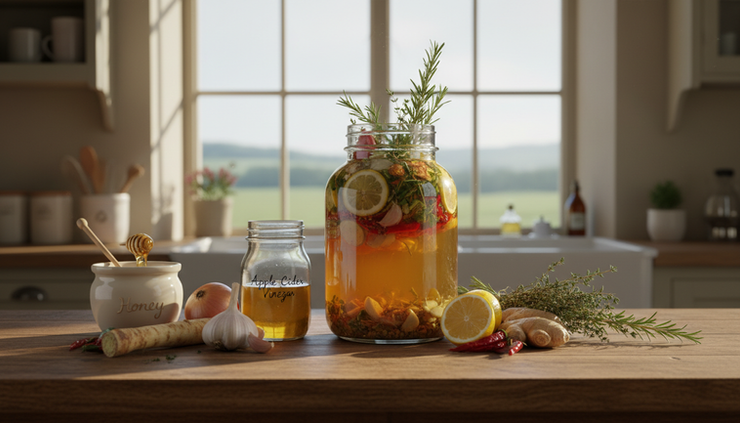
Fire cider, as a named preparation, comes out of a classroom kitchen. In the winter of 1979–1980, herbalist Rosemary Gladstar was teaching winter-health classes at the California School of Herbal Studies in Forestville. She wanted a non-alcoholic tonic that felt like food as much as medicine. With students, she packed grocery-store “fire” — garlic, onion, horseradish, ginger, hot pepper — into apple cider vinegar, waited weeks, and then added honey to blunt the edges. They called it fire cider.
Fire Cider is a sharp vinegar oxymel, meaning a sweet-sour preparation made with vinegar and honey. It belongs in the kitchen, the pantry, and maybe your damp-cold week comfort routine. Most versions include some mix of:
Apple cider vinegar
Fresh horseradish
Garlic
Onion
Ginger
Hot peppers or cayenne
Citrus peel or juice
Herbs such as rosemary or thyme
Honey
The ingredients steep in vinegar for a few weeks. Then you strain the liquid and stir in honey until it tastes balanced. The finished cider is hot, sour, pungent, and a little sweet.
That puts it in the family of oxymels, an old style of preparation made from vinegar and honey. The word comes from Greek roots meaning acid and honey. People have mixed vinegar, honey, herbs, and spices in different ways for a very long time, both as food and as household remedies.
Fire cider, though, is its own modern recipe family. It’s not just any oxymel. The “fire” comes from pungent roots and chiles. Horseradish gives it that nose-clearing bite. Garlic and onion bring sulfurous heat. Ginger adds warmth. Chile brings the burn. Honey rounds the edges so it doesn’t taste like punishment.
Where fire cider comes from
The general idea of vinegar and honey preparations is old. The specific spicy tonic now known as fire cider is widely credited to herbalist Rosemary Gladstar, who taught and shared a version in the late 1970s and early 1980s.
Chemically and gastronomically, fire cider is an oxymel with extra heat. An oxymel is vinegar plus honey. The word is from Greek oxymeli — acid and honey — and the preparation is old in a way fire cider itself is not. Hippocratic texts discuss oxymel as a drink that can loosen sputum and ease breathing in acute illness. Persian medical traditions kept a related drink as serkangabin or sekanjabin. Later European herbals treated oxymels as vehicles for herbs: sour enough to extract, sweet enough to swallow, stable enough to keep.
So fire cider sits in a long family without being identical to any ancestor. Vinegar infusions are older than Gladstar. Honey-and-vinegar drinks are older still. The specific American blend — horseradish-forward, allium-heavy, chile-hot, finished with honey and sold or shared under that name — is a modern folk standard that spread through herb schools, potlucks, zines, and eventually farmers’ markets.
Two other cousins get mentioned whenever the history is told honestly. One is Four Thieves vinegar, a legendary European plague-era herb vinegar whose surviving recipes are more story than laboratory notebook. The other is the mid-century Vermont pantry tonic popularized by country physician D.C. Jarvis: apple cider vinegar, honey, and often cayenne.
Gladstar has said those older vinegar formulas were part of the background noise when she and her students built the hotter version. John Christopher’s school of American herbalism sits in that same mid-century current. Fire cider did not descend from a single sacred recipe. It was assembled from common kitchen plants and an already circulating idea that vinegar could carry heat.
Gladstar’s recipe became popular in American herbal circles because it was simple, cheap, and easy to adapt. You didn’t need rare ingredients. You needed a jar, vinegar, roots, spices, and time.
That explains why there are so many versions now. Some people add turmeric. Some add black pepper. Some add orange. Some skip onion. Some make it fiery enough to make your eyebrows sweat. Some keep it mellow.
That origin also explains the legal fight that made the name famous outside herb shops. In 2012 a Massachusetts company, Shire City Herbals, registered “Fire Cider” as a trademark and sent cease-and-desist pressure toward small makers. Herbalists argued the name had been generic in their community for decades. After years of organizing and a federal case, a judge ruled in 2019 that fire cider is a generic term. No one owns it. That ruling matters less as folklore and more as a reminder of what the product actually is: a shared American folk remedy, not a brand invention and not a tribal secret.
You don’t need to know every detail of that legal fight to understand the main point: fire cider is part of recent American herbal culture, especially community herbalism. It was popularized through teaching, books, workshops, home kitchens, and small apothecaries.
What gets shaky is when people try to make it sound older, more exotic, or more authoritative than it is.
Calling it “ancient Native medicine” without a specific source is a red flag. There are hundreds of Native nations, each with distinct histories, foods, plant relationships, and medical traditions. There isn’t one generic Native protocol.
Many common fire cider ingredients come from different parts of the world:
Horseradish is native to parts of Europe and western Asia.
Ginger comes from Asia and has a long history in Asian food and medicine.
Garlic and onion have deep histories across Eurasia and the Mediterranean.
Chile peppers come from the Americas and spread globally after colonization and trade.
Apple cider vinegar depends on apples, which have their own long and complicated travel history.
That global mix doesn’t make fire cider fake. It makes it modern folk food. Modern folk food can still be meaningful. It just doesn’t need a made-up origin story.

What fire cider is not
Wellness culture turned fire cider into a morning shot, a flu-season talisman, a claim that the immune system can be “boosted” the way a phone is charged. The evidence does not follow the marketing hype. Fire cider can be useful and enjoyable without pretending to be something it isn’t. The trouble starts when marketing turns a spicy vinegar into a miracle bottle.
There are no good clinical trials of fire cider as a finished product for preventing colds, shortening flu, or modulating immunity in healthy people. Reviews of the drink keep landing on the same sentence: individual ingredients have interesting laboratory or small-study stories; the combination in this jar has not been shown to do what the labels imply. Cleveland Clinic dietitians have said there is no real rationale for taking it as an immune product. “Boosting” immunity is not even a coherent goal in most healthy adults.
There is no documented pre-colonial Native American formula that matches this preparation:
-Old World apple cider vinegar, Eurasian horseradish (Armoracia rusticana), garlic and onion as used here, ginger, cayenne or other chiles in a Gladstar-style mash, honey, and the English name “fire cider.”
-Apples and apple vinegar as we know them are not Indigenous to the Americas in the form this recipe requires.
-Horseradish is a European brassica.
-The named recipe and teaching lineage run through a California herb school in 1979–1980 and the subsequent American herbalist circuit.
Gladstar herself has been explicit that there was no “ancient Fire Cider recipe” sitting in the archive before that classroom batch. Older vinegar-and-honey drinks existed. This one, under this name and this ingredient logic, did not.
That does not mean Indigenous nations lacked pungent medicines, fermented drinks, or winter tonics. They did, in many distinct traditions, with plants and methods that belong to those nations. Collapsing those into a mason-jar trend from the back-to-the-land herbal revival is not respect. It is a shortcut. It also erases the actual, more modest lineage: Mediterranean oxymel, European medicinal vinegars, New England cider-vinegar folklore, and a 1970s teaching kitchen that wanted something students could make after class.
If a seller wants to talk about Indigenous plant knowledge used in their product, they should name the people, the plant, the region, and the source. Treating it as a pan-Native protocol is a marketing gimmick.
It isn’t a proven cold or flu treatment
Garlic, ginger, chile, horseradish, and related pungent foods contain compounds that researchers have studied for different effects. Garlic contains sulfur compounds. Ginger contains gingerols. Chiles contain capsaicin. Vinegar is acidic. Honey can soothe coughs for some people over age 1.
Garlic has sulfur compounds that look antimicrobial in a dish or a petri dish.
That is not the same as a daily shot preventing respiratory viruses in a household.
Ginger can settle nausea for some people and feels warming.
Horseradish and chile make the nose run; a brief sinus-clearing reflex is not antiviral therapy.
Apple cider vinegar is acetic acid in water, useful in food, harsh on enamel, and only modestly interesting for post-meal blood sugar in some studies of vinegar generally — not a reason to treat fire cider as metabolic medicine.
Honey can soothe a cough in children over one year old better than some over-the-counter syrups in limited trials; that is a throat effect, not an immune reboot.
That’s interesting. It’s also not the same as proof that a spoonful of fire cider prevents colds, treats flu, or shortens an infection.
The National Center for Complementary and Integrative Health has reviewed popular herbs like garlic and ginger. The overall message is cautious: some traditional uses are plausible, some research is promising in narrow areas, but evidence for preventing or treating common colds is limited or mixed.
Also, fire cider recipes vary wildly. One jar might be mostly vinegar and onion. Another might be loaded with garlic and chile. Another might steep for two weeks. Another for eight. That makes it hard to make reliable health claims.
So if someone says, “This cures colds,” step back.
If someone says, “I like a spoonful in hot water when I’m chilled and stuffy,” that’s much more reasonable.
It doesn’t “boost immunity” in a simple way
“Boost your immune system” sounds good, but the phrase is usually hype that connot show proof.
The immune system isn’t a single muscle you strengthen by taking a daily shot. It’s a complex network of cells, barriers, signals, inflammation, and repair. More immune activity isn’t always better. Allergies, autoimmune disease, and chronic inflammation all involve immune responses that are too active or misdirected.
What actually supports immune health in the real-world sense?
Enough sleep
Regular meals with enough protein and plants
Handwashing and ventilation
Managing stress where possible
Specific herbs with specific purpose
Moving your body
Treating chronic conditions
Staying home when you’re contagious
A spicy vinegar tonic doesn’t replace those.
Fire cider may fit into a nourishing routine because it helps food taste good. If it gets you to eat a bowl of lentil soup, sautéed greens, or broth with vegetables, great.
But a daily burning shot on an empty stomach isn’t wellness. For some people, it’s just reflux waiting to happen.
It isn’t automatically safe for everyone
Because it’s made from common foods, fire cider can seem harmless. Often, in small culinary amounts, it is. But concentrated acidic, spicy preparations can bother people.
Be careful with it if you deal with:
Acid reflux or GERD
Stomach ulcers or gastritis
Sensitive teeth or enamel erosion
Irritable bowel symptoms triggered by garlic, onion, or chile
Kidney disease or potassium restrictions
Blood-thinning medication or upcoming surgery, especially with high garlic intake
Pregnancy-related reflux or nausea
Allergies to any ingredient
Honey also isn’t safe for children under 12 months because of the risk of infant botulism. That’s standard guidance from public health sources like the CDC.
This post is for general information and kitchen education. If you’re treating illness, managing a condition, pregnant, giving something to a child, or taking medication, ask a qualified clinician.
Don’t confuse marketing hype with treatment for strep, flu, COVID, pneumonia, or anything that needs real care. If you have a high fever, trouble breathing, chest pain, dehydration, symptoms that worsen, or symptoms that won’t let up, get medical advice.
It isn’t better because it hurts
There’s a strange wellness idea that if something burns, shocks, purges, or tastes terrible, it must be working.
Nope.
Strong flavors can be pleasant. They can open your nose for a moment. They can make you feel alert. They can warm your chest because capsaicin and pungent aromatics create real sensory effects.
But pain is not proof.
If fire cider makes your throat burn badly, gives you stomach pain, triggers reflux, or makes you dread taking it, dilute it or stop using it. You’re allowed to enjoy your food.
Who should leave the jar on the shelf
Vinegar is acidic. Chile and raw alliums are aggressive. The combination is hard on some bodies.
People with GERD, gastritis, or active ulcers often feel worse, not clearer. Acid plus capsaicin is a predictable insult to an irritated esophagus. Frequent undiluted shots can erode tooth enamel; dilute, use a straw if you insist, rinse with water, and do not brush immediately after. Honey must never go to infants under twelve months because of botulism risk. Pregnancy and nursing sit in the usual herbal gray zone: culinary amounts in food are not the same as concentrated daily tonics, and raw garlic, hot pepper, and unpasteurized products are worth running past a clinician if someone is actually drinking this as a supplement. Garlic and other ingredients can interact with blood thinners or diabetes medications in theory; that is a conversation with a pharmacist, not a blog comment.
“Natural” does not mean gentle. A preparation designed to make your eyes water is allowed to be optional.
How to make a grounded version at home
You don’t need a perfect recipe. You need a clean jar, enough vinegar to cover the solids, and a sense of taste.
Here’s a flexible version.
Ingredients
For about 1 quart before straining:
1 small onion, chopped
1 head garlic, cloves peeled and lightly crushed
1/2 cup fresh grated or chopped horseradish
1/2 cup fresh sliced ginger
1 to 2 fresh hot peppers, sliced, or 1/2 teaspoon cayenne
Peel and juice of 1 lemon or orange, preferably unwaxed or well scrubbed
1 to 2 sprigs rosemary or thyme, optional
Apple cider vinegar with 5% acidity, enough to cover
Raw honey, to taste, added after straining
You can add turmeric if you like the earthy flavor. If you do, add a few grinds of black pepper. Not because it turns the jar into medicine, but because turmeric and black pepper taste good together in a warming, earthy way.
Method
Wash your jar and tools well.
You don’t need to sterilize like you’re canning, but start clean.
Prep the ingredients.
Chop roots and alliums small enough to expose surface area. Wear gloves if you’re handling hot peppers or fresh horseradish.
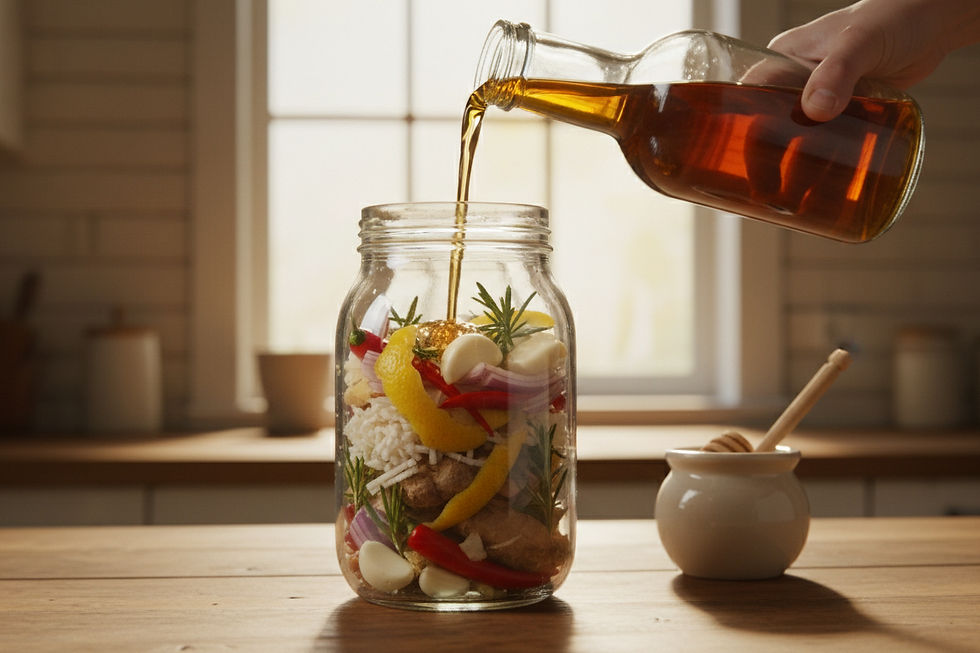
Pack the jar loosely.
Don’t mash everything down into a solid brick. Vinegar needs to move around the ingredients.
Cover completely with vinegar.
Use apple cider vinegar labeled 5% acidity. Make sure the plant material stays under the liquid. A fermentation weight can help.
Use a nonreactive lid.
Vinegar can corrode metal. Use a plastic lid, a glass lid, or a piece of parchment between the jar and a metal lid.
Steep in a cool, dark place.
Two to four weeks is common. Shake the jar daily or whenever you remember.
Strain well.
Use a fine mesh strainer or cheesecloth. Press the solids to get the good stuff out.
Sweeten with honey.
Add honey slowly. Start with a few tablespoons, taste, and adjust. Some people like it barely sweet. Some like it closer to a shrub.
Store it cold.
Refrigeration is the safest default for homemade infused vinegars, especially when recipes vary. Label the jar with the date.
The National Center for Home Food Preservation gives careful guidance around flavored vinegars because acidity, ingredient prep, and storage matter. Home recipes aren’t all the same. If you see mold, bubbling that seems unusual, slime, a rotten smell, or anything that makes you pause, throw it out.
Don’t scrape off mold and keep going. Vinegar is cheap. Your health is not.
A note on raw vinegar and “the mother”
Apple cider vinegar with “the mother” is popular, and it’s fine to use if you like it. “The mother” is a mix of cellulose and acetic acid bacteria that can form during vinegar production.
It doesn’t make fire cider magically stronger. Clear apple cider vinegar works too, as long as it has the right acidity.
More important than cloudiness is the label. For safe kitchen infusions, use vinegar that says 5% acidity.
What to do with the strained solids
The leftover solids will be intense. Some people compost them. Some blend a small amount into marinades or hot sauce. If you do that, keep it refrigerated and use it quickly. I've also read about drying the marc, grinding it into powder and using it as seasoning.
Don’t feel guilty if you toss them. They’ve given a lot to the vinegar.
How to use it without turning it into a cure-all
The easiest way to use fire cider well is to stop treating it like a cure-all supplement and start treating it like a condiment. Use it first as food. That is the most honest application and the one that matches how vinegar extracts have always lived in kitchens.
A tablespoon in food makes more sense than a forced shot every morning. You’ll taste it better, digest it better, and avoid turning a beautiful herbal preparation into a chore.
Try it in places where vinegar already belongs. A spoon of fire cider in a vinaigrette does what shallot and mustard do, only louder. It cuts through roast vegetables, beans, and grain salads. A splash at the end of a lentil soup or a pot of greens is better than a daily ounce taken grimly at the sink.
The folk use that still makes sense is narrower than “immunity.” Gladstar framed it as a warming, decongesting winter tonic. Herbalists often talk about it for cold, damp conditions: wet weather, sluggish appetite, a stuffed head, the first scratch of a throat when you want something hot and sharp. That is traditional Western herbal pattern language — energetics and tissue-state framing (cold/damp, congested, stagnant) used to match a remedy to a presentation — not a biomedical diagnosis.
Chile and horseradish make the nose run. Vinegar and honey are an old pair for a sore throat. Warmth is comfort when the house is clammy. A teaspoon in hot water when you already feel rough is a different act from a wellness shot taken in August because a reel said so.
Here are some realistic ways to incorporate fire cider into actual holistic support:
Stir it into soup
This is my favorite use. Add a teaspoon or two to a bowl of lentil soup, chicken soup, bean soup, ramen, or vegetable broth right before eating.
Acid at the end of cooking makes flavors pop. That’s basic cooking, not a health claim.
Make a fast vinaigrette
Use it on sturdy greens, roasted carrots, grain bowls, cabbage slaw, or potato salad.
The garlic, onion, chile, and vinegar are already built in, so you barely need anything else.
Add it to hot water as a true tonic
A small spoonful in hot water can be nice when the weather is raw and you want something sharper than tea. Add extra honey if your throat feels scratchy.
Use it like hot sauce
Fire cider is thinner than most hot sauces, but it works the same way. If you enjoy hot vinegar on Southern greens, pepper vinegar, escabeche brine, or pickled jalapeño juice, this will make sense right away.
Keep the serving small
A common serving is 1 teaspoon to 1 tablespoon. More isn’t automatically better.
If you’re new to it, dilute it. Take it with food. Rinse your mouth with water afterward if you’re worried about tooth enamel. Don’t brush immediately after acidic foods or drinks, since enamel can be temporarily softened.
And if it doesn’t agree with you, skip it. There are many ways to enjoy warming flavors: ginger tea, garlic soup, chile crisp, pickles, broth, lemon-honey tea, or a good bowl of pho.
Fire cider doesn’t have to be everyone’s thing.

A better way to think about Fire Cider
The real fire cider origin story is simple, honest evolving American Herbal Tradition.
Calling it Indigenous lends borrowed gravitas. Calling it an immunity shot borrows the authority of public health without the trials.
Both moves taint the actual history, which is actually more interesting: people have mixed vinegar and honey for a very long time; Americans in the herbal revival made a hotter regional version and taught it freely; a well-loved American Herbalist created a fiery tonic; a company tried to own the name and lost; the internet then sold the idea as a cure all.
If you make fire cider this fall, make it because you want herbal tonic support that can be a fierce vinaigrette and a throat-warming spoonful when the weather turns wet. Credit Gladstar and the students who named it. Credit oxymel and cider-vinegar folklore if you like old recipes. Do not hang it on Native nations that did not invent it. Do not expect it to replace sleep, ventilation, or a doctor.
A good folk remedy has a legitimate place in holistic wellness. A diluted tonic, a nutritional support, used through a stretch of cold damp days. That is the honest use.
It’s a strong homemade vinegar infused with pungent kitchen plants. It comes to us in its current named form through modern American herbalism, with Rosemary Gladstar’s teaching playing a major role. It belongs to the broad family of honey-vinegar preparations, but that doesn’t make every claim about it true.
Give credit where credit is due. Don’t dress it up in a vague Indigenous origin story. Don’t sell it as an immunity shield. Don’t punish your stomach with daily shots because the internet makes fabulous claims.
A grounded jar of fire cider can be plenty special without the hype. Peace
All information provided on this website, including blog posts, articles, and any related content, is for general informational and educational purposes only. It is not intended to diagnose, treat, prescribe, cure, mitigate, or prevent any medical condition or disease. Always consult a qualified healthcare provider before making any changes to your health regimen, including the use of herbs, teas, foods, or supplements discussed here. The author is not a licensed medical professional, and this content does not replace professional medical advice, diagnosis, or treatment. The author and One Stop Apothecary are not responsible or liable for any adverse effects, consequences, or outcomes resulting from the application or use of any suggestions, preparations, or information presented herein. Any use of this material is at the reader's own discretion and sole responsibility. These statements have not been evaluated by the Food and Drug Administration (FDA). This information is not intended to diagnose, treat, cure, or prevent any disease.
History, naming, and the trademark case
The Battle for the One, True ‘Fire Cider’ — The New York Timeshttps://www.nytimes.com/2019/03/16/style/fire-cider-herbalist-shire-city.html
Free Fire Cider: Traditional Remedy Remains Generic after Landmark Case — HerbalGram (American Botanical Council), Issue 125https://www.herbalgram.org/resources/herbalgram/issues/125/table-of-contents/hg125-feat-firecider/
Shire City Herbals, Inc. v. Blue, Civil Action No. 15-30069-MGM (D. Mass.) — judgment / case recordhttps://www.casemine.com/judgement/us/5d95814d342cca256a7875e3
Judge: Term ‘fire cider’ too generic for trademark — The Berkshire Eaglehttps://www.berkshireeagle.com/archives/judge-term-fire-cider-too-generic-for-trademark/article_22ba0d07-f9a7-5c34-90fa-e7ac827829bb.html
Herbalists defended their brew in court. They won. — The Boston Globehttps://www.bostonglobe.com/metro/2019/10/20/herbalists-defended-their-brew-court-they-won/r94hvWnBghLvdwsnw7W7JN/story.html
What’s All the Fuss About Fire Cider? — Rosemary Gladstar / Science & Art of Herbalismhttps://scienceandartofherbalism.com/whats-all-the-fuss-about-fire-cider/
Fire Cider — A Tradition, Not A Trademark — Rosemary Gladstar in Spirit of Changehttps://www.spiritofchange.org/?p=21782
Tradition Not Trademark: Fire Cider Goes to Court — Hachette / Gladstar updatehttps://www.hachettebookgroup.com/wp-json/wp/v2/posts/1329601
Free Fire Cider – Tradition NOT Trademark (Gladstar background text) — Old Factory Soaphttps://oldfactorysoap.com/free-fire-cider/
Fire Cider: A Folk Remedy, a Legal Battle, and a Story of Resilience — Herbal Revolution (Kathi Langelier)https://www.herbalrev.com/blogs/wellness/fire-cider
Deborah Balmuth: A victory for Gladstar, herbalist community — The Berkshire Eaglehttps://www.berkshireeagle.com/opinion/columnists/deborah-balmuth-a-victory-for-gladstar-herbalist-community/article_396e2267-7cac-50e1-b0a3-5c0301babcca.html
Fire cider — Wikipediahttps://en.wikipedia.org/wiki/Fire_cider
What fire cider is (oxymel, recipe lineage, culinary use)
Oxymel: A systematic review of preclinical and clinical studies — PMChttps://pmc.ncbi.nlm.nih.gov/articles/PMC10730569/
On Regimen in Acute Diseases, Part 16 (oxymel) — Hippocrates, Internet Classics Archivehttps://classics.mit.edu/Hippocrates/acutedis.16.16.html
Oxymel — Wikipediahttps://en.wikipedia.org/wiki/Oxymel
Oxymel Is the Tart, Herbal Tonic You Can Make at Home — Bon Appétithttps://www.bonappetit.com/story/make-oxymel-herbal-tonic
Fire Cider: Benefits and History of Medicinal Vinegars — Mother Earth News (Four Thieves / vinegar lineage)https://www.motherearthnews.com/natural-health/herbal-remedies/fire-cider-benefits-zm0z23onzawar/
Fire Cider Recipe (Sour and Sweet) — The Kitchnhttps://www.thekitchn.com/recipe-fire-cider-recipes-from-the-kitchn-199972
FIRE CIDER RECIPE (source: Rosemary Gladstar) — Willimantic Food Co-op PDFhttps://www.willimanticfood.coop/images/recipes/wfc-recipe_Fire-Cider.pdf
Fire Cider Recipe: How to Make This Traditional Herbal Tonic — The Old Farmer’s Almanachttps://www.almanac.com/how-make-fire-cider
What it is not (immunity claims, evidence, safety)
Fire Cider Benefits: Is It Worth It? — Cleveland Clinichttps://health.clevelandclinic.org/fire-cider-benefits
Fire Cider: Myth or Miracle Immunity-Boosting Tonic? — Healthlinehttps://www.healthline.com/nutrition/fire-cider-benefits
Fire cider: Benefits, side effects, and recipe — Medical News Todayhttps://www.medicalnewstoday.com/articles/fire-cider-benefits
Can fire cider really boost health and ward off colds? — Center for Science in the Public Interesthttps://www.cspi.org/cspi-news/can-fire-cider-really-boost-health-and-ward-colds
What Is Fire Cider—And Does It Actually Prevent Cold and Flu Symptoms? — SELFhttps://www.self.com/story/fire-cider-tiktok-trend
Fire Cider Benefits, Ingredients, and Nutrition Info — GoodRxhttps://www.goodrx.com/well-being/diet-nutrition/fire-cider-health-benefits
These are the sources that shaped the blog’s history, oxymel framing, Gladstar origin, trademark outcome, Native-protocol correction, immunity-shot critique, culinary use, and cautions.


Comments