
Bee Balm Benefits and Limits - A Native Mint Family Antimicrobial
Bee balm smells like oregano, thyme, citrus, and mint had a loud garden party. That smell is the point. It comes from aromatic compounds that have a real herbal history, especially thymol and carvacrol.
Bee balm won’t “mineralize” your body. It won’t replace antibiotics. It won’t cure a chest infection. But it’s a useful native herb with a long record of use for digestion, sore throats, coughs, and simple household preparations.
That makes it worth knowing. Especially if it’s already growing in your yard.

Bee balm is a native mint, not a miracle cure
Bee balm is the common name for plants in the Monarda genus. These plants belong to the mint family, Lamiaceae. That puts them in the same broad family as thyme, oregano, basil, sage, rosemary, and peppermint.
The useful names are Monarda didyma and Monarda fistulosa. The first is the scarlet plant often called Oswego tea. The second is wild bergamot, the wider-ranging lavender-pink plant of fields and roadsides. Both are in the mint family. Both carry aromatic oils in the leaves and flowers. Both have a documented traditional lane: digestion after heavy food, short-term cold and throat discomfort, and simple external use on intact skin.
In North America, several Monarda species grow in gardens, meadows, prairie edges, and roadside patches. Common ones include:
Monarda fistulosa, often called wild bergamot
Monarda didyma, often called scarlet bee balm or Oswego tea
Monarda punctata, often called spotted bee balm or horsemint
Monarda citriodora, often called lemon bee balm
The names can get messy. “Bergamot” also refers to the citrus fruit used to flavor Earl Grey tea. Bee balm is not that fruit. Wild bergamot got the name because some species have a citrusy, spicy aroma that reminded people of bergamot orange.
Do not confuse it with lemon balm (Melissa officinalis). Shops and search results use “bee balm” for both. They are different plants with different jobs. If a bag only says bee balm, ask which Monarda you have.
The USDA PLANTS database lists Monarda species as native across much of North America, depending on the species. That matters. This isn’t an exotic superfood with a marketing team. It’s a local, mint-family plant with practical uses.
Gardeners love bee balm because pollinators love it. Bees, butterflies, and hummingbirds visit the flowers. Herbalists value the leaves and flowering tops. The plant has a strong scent because it makes volatile oils. Those oils are where much of the traditional use starts.
That scent also explains why different bee balm plants can taste different.
Some taste like oregano and thyme. Some lean lemony. Some taste hot, sharp, and medicinal. Soil, species, genetics, harvest time, and drying all change the final aroma.
The key point is simple: bee balm is useful because of its aromatics, not because it contains rare minerals or needs a dramatic wellness story.
How people actually used it
Native nations across a wide range used Monarda, especially M. fistulosa. Recorded uses cluster in a few places: colds, coughs, congestion, feverish states, sore mouth and throat, gas and belly cramp, and poultices for cuts, boils, and bites. Some used it as a diaphoretic—to encourage sweat when a person was already feverish—not as a daily tonic. The Blackfoot used it for its strong antiseptic action on skin. Several nations used tea for dental and throat discomfort. The Oneida tradition that calls wild bergamot “Number Six” belongs to that living use. It is not a slogan.
M. didyma is the Oswego tea plant associated with the Oswego people in what is now New York. After the Boston Tea Party, colonists drank native plants as Liberty teas. M. didyma was in that mix. That history shows a local aromatic mint already sitting in the cup when imported leaf was not wanted. It does not turn the plant into a mascot.
Western herbal writing later filed bee balm with the carminatives and the short-term respiratory aromatics—the same shelf as thyme and oregano, which is the right neighborhood. Michael Moore and other field herbalists treated Monarda as a stimulating, drying, aromatic plant for stagnant digestion and hot, congested upper airways. That matches the older record better than any modern “wellness” pitch.
The antimicrobial reputation comes from thymol and carvacrol
When people call bee balm antimicrobial, they’re usually talking about its essential oil chemistry.
Many Monarda species contain phenolic compounds found in other strong herbs, especially:
Compound | Also found in | Why it matters |
Thymol | Thyme, oregano, some bee balm species | Studied for antimicrobial activity in lab settings |
Carvacrol | Oregano, thyme, some bee balm species | Studied for effects on bacterial and fungal cell membranes |
Geraniol | Rose, lemon balm, some Monarda species | Aromatic compound with research interest |
Linalool | Lavender, basil, many aromatic plants | Fragrant compound with calming aroma and topical relevance |
Thymol and carvacrol are the big names. They’re both found in herbs people already recognize as “strong,” like thyme and oregano. Lab research on these compounds shows activity against a range of microbes. The usual explanation is that they can disrupt microbial cell membranes.
That sounds impressive, but keep it in the right lane.
Thymol and carvacrol
Bee balm’s character comes from its essential-oil fraction. Across Monarda species, the dominant compounds are often thymol, carvacrol, p-cymene, and related monoterpenes. Some samples of M. fistulosa run high in thymol. Others lean carvacrol or thymoquinone. M. didyma oils in several analyses have been thymol-forward. Harvest timing, plant part, and growing site change the ratio. A flowering plant is not chemically identical to a leafy one.
Thymol is the same phenolic compound that made thyme useful and that later appeared in commercial mouth rinses. Carvacrol is the oregano-family isomer. In laboratory tests, both disrupt microbial cell membranes. Distilled Monarda oils have shown activity against a range of bacteria and some fungi. In some test systems the oils looked a little harder on pathogenic strains than on certain beneficial ones. That is interesting. It is also a petri dish. A covered mug of tea is not an antibiotic. A steam is not a prescription.
What the chemistry reasonably supports is the traditional job: an aromatic, warming, slightly drying plant for short digestive discomfort, for a raw throat or congested head over a few days, for a gargle, and for simple topical care when you know the plant and you keep the preparation mild. It does not support a daily defense extract. It does not support swallowing the essential oil.
Water also pulls other compounds—rosmarinic acid and related phenolics among them. They belong in a full picture of the tea. They do not turn the tea into a multi-target product.
Chemotype matters for the cook as much as for the herbalist. A mild M. didyma cup is a different dose than a fiery M. fistulosa cup. If the tea burns going down, you used too much of a hot plant, not “a stronger medicine.” Use less.
A petri dish is not a human body. Essential oil chemistry is not the same as drinking a cup of tea. A dried herb infusion contains water-soluble compounds and some volatile aromatics, but it’s not concentrated essential oil.
So yes, bee balm has a fair antimicrobial tradition. Yes, its chemistry supports that reputation. No, that doesn’t mean a cup of bee balm tea treats an infection.
The safest way to say it is this:
Bee balm has aromatic compounds with documented antimicrobial activity in lab research, and it has a long tradition of use for minor digestive and respiratory complaints.
That’s useful. It’s also honest.
Bee Balm: Native Antimicrobial works as a nickname when you mean traditional household use and plant chemistry. It fails when people stretch it into a cure-all.
Different species can feel like different herbs
Not all bee balm is the same.
Monarda fistulosa often has a thyme-oregano character. Monarda didyma can taste warmer, mintier, and softer. Monarda punctata can be especially strong and resinous. Monarda citriodora often has a lemony note.
That matters when you use it.
A mild, lemony bee balm makes a pleasant tea. A hot, oregano-like bee balm may work better in a steam, syrup, gargle, or savory kitchen use. Strong plants can overwhelm a cup fast.
If you grow bee balm, crush one leaf and smell it. Then taste a tiny bit. Your nose will tell you a lot.
Essential oil is not the same as the herb
This part needs to be clear.
Bee balm essential oil is concentrated. A few drops can represent a lot of plant material. Essential oils rich in thymol or carvacrol can irritate skin and mucous membranes. They should not be swallowed casually.
Traditional use of bee balm usually means tea, infused honey, steam, gargle, culinary use, or topical preparations made with the whole herb. That’s different from taking the essential oil internally.
If you’re working with essential oils, use trained guidance. For home use, the dried or fresh herb is the better starting point.
Traditional digestive uses make sense
Bee balm sits naturally in the same home-herb category as peppermint, thyme, oregano, and lemon balm. That means one of its best-known uses is digestive support.
Traditional herbalists have used bee balm tea for:
Gas
Bloating
Nausea
Heavy meals
Mild cramping linked with digestion
A “stuck” feeling after eating rich food
This is the use most people can judge without a theory. After a heavy meal, with gas and that tight, stuck feeling in the belly, bee balm sits with thyme and oregano. Carminative herbs help move gas and ease spasm. Native use as a carminative matches that. You are not cleansing anything. You are using an aromatic mint so a sluggish gut can do work it already knows how to do.
This use fits its chemistry and taste. Aromatic mint-family herbs often act as carminatives. That word means they help ease gas and support comfortable digestion. Peppermint is the famous example. Fennel, anise, thyme, and lemon balm also show up in this category.
Bee balm is sharper than lemon balm and often hotter than peppermint. That makes it feel warming. Many people use it after a heavy meal, especially when the herb has that oregano-thyme bite.
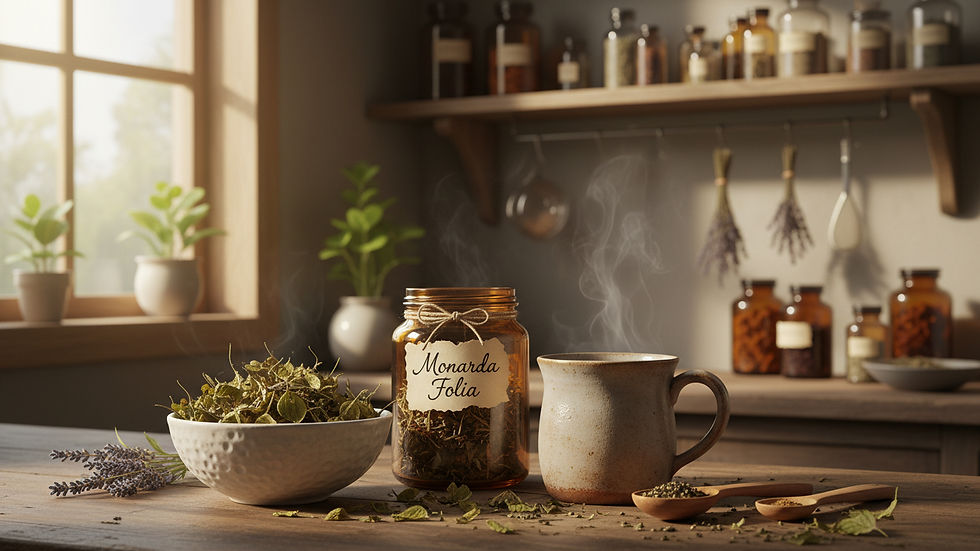
A simple tea is the standard preparation.
Use:
1 to 2 teaspoons dried bee balm leaf and flower
8 ounces hot water
A covered mug
10 minutes of steeping time
Cover the cup while it steeps. Volatile oils escape with steam. A lid keeps more aroma in the tea.
Start with the lower amount if your bee balm is strong. Some plants make a tea that tastes almost like diluted oregano oil. That’s not bad, but it can be too much.
Fresh herb works too. Use a small handful of fresh leaves and flowers per mug. Bruise them lightly before steeping.
Bee balm after meals
For digestion, bee balm usually works best after eating, not on an empty stomach. The flavor cuts through richness. It pairs well with lemon, honey, or a little fresh ginger.
This is food-adjacent use, Nutritional Herbology in action. A cup after supper for a few evenings is not the same as drinking it all season because you read that thymol is antimicrobial. If digestion is a chronic medical problem, tea is not the clinical plan.
A practical after-dinner blend:
Bee balm
Peppermint
Lemon balm
A small slice of ginger
This blend tastes cleaner than straight bee balm. Peppermint cools it down. Lemon balm softens it. Ginger adds warmth without making it taste like pizza seasoning.
That last point matters. Strong Monarda fistulosa can taste savory. If you don’t like that in tea, use it in food.
Culinary use is underrated
Culinary use is older than capsules. Young leaves have gone into meat, beans, jellies, and pot liquor the way people use oregano. That is a legitimate way to keep the plant in the house without turning it into a protocol.
Bee balm leaves can season beans, roasted vegetables, marinades, soups, and tomato dishes. Use it the way you’d use oregano or thyme, but start with less. It can dominate.
Chopped fresh bee balm can work in:
Lentil soup
White bean salad
Roasted potatoes
Corn salad
Tomato sauce
Herb vinegar
Compound butter
This is one of the easiest ways to use the plant without turning it into medicine. Food-level use is often the best fit for everyday herbs.
Respiratory use is mostly about aromatics and comfort
Bee balm has a long history as a respiratory herb. People have used it for colds, stuffy noses, sore throats, coughs, and winter teas.
Tradition puts bee balm on colds, catarrh, sore throat, and short feverish states where sweat was already part of the picture. The oils are volatile. You smell them before you swallow them. That is part of how a steam or a hot cup helps a congested head.
Keep the course short. A few days while you rest, drink water, and eat simply is the lane. Bee balm is not a plan to stay well from September to April. It does not replace a look at a cough that lingers, breathing that is hard, a fever that stays high, or illness in an infant or an elder.
Again, don’t turn that into a treatment claim. Bee balm doesn’t replace medical care for pneumonia, flu, COVID, strep throat, asthma attacks, or any serious breathing problem.
But for minor seasonal discomfort, the plant has a clear role.
Aromatic herbs can help in three practical ways:
Steam carries scent into the nose and throat
Warm tea soothes irritated tissue
A gargle can coat the throat briefly
That’s simple. It’s not magic.
Steam is straightforward. Pour a hot infusion into a bowl. Sit over it with a towel for a few minutes. Keep your eyes closed. Stop if you feel lightheaded. Do not add essential oil to that bowl unless you already know how to dilute phenolic oils. Leaf tea is enough at home.
A warm gargle from the same tea can comfort a raw throat. Spit it out. You do not need to swallow a mouthful of strong tea to get that local effect.
Some older uses include whooping cough and bronchitis. Those are historical notes, not home treatment plans for serious lower-airway disease.
For a sore throat, tea or gargle makes more sense. Brew a strong infusion, let it cool until warm, then gargle and spit. Honey can make the tea more soothing if you’re drinking it. Do not give honey to children under 1 year old.
For a cough linked with throat tickle, a bee balm honey can be useful. It brings the aromatics into a thick, soothing base.
Easy bee balm honey
Use clean, dry herb. Fresh herb contains water, which can raise spoilage risk if it sits in honey too long.
Basic method:
Fill a small clean jar one-third full with dried bee balm.
Cover with raw or regular honey.
Stir to remove air pockets.
Cap the jar.
Let it sit for 1 to 2 weeks.
Strain if you want, or leave the herb in if it stays fully covered.
Use a spoonful in warm tea. Don’t boil the honey. High heat drives off aroma and changes the flavor.
This is a comfort preparation. Treat it that way.
Oswego tea and historical use
Monarda didyma is often called Oswego tea. The name is tied to the Oswego people and to colonial-era use of the plant as a tea. Ethnobotanical records also describe uses of Monarda species among Indigenous communities for colds, fevers, digestive complaints, and topical applications.
That history deserves respect. It’s not a branding hook. It’s part of the plant’s story.
European settlers also used bee balm as a tea substitute. That history is commonly linked to the period after the Boston Tea Party, when imported black tea became politically and economically charged in the colonies.
The takeaway isn’t that bee balm tea copies black tea. It doesn’t. The flavor is minty, spicy, and herbal. The takeaway is that this plant has been used as a household herb for a long time.

How to harvest and prepare bee balm without overdoing it
Bee balm is easiest to use when you harvest it at the right time.
The leaves are aromatic before bloom. The flowering tops are often strongest when the flowers have just opened. Harvest on a dry morning after dew has lifted. Avoid plants sprayed with pesticides or growing along busy roads.
Cut the top one-third of the stems. Don’t strip a plant bare. Leave plenty for pollinators and for the plant to keep growing.
Bundle the stems loosely or spread them on a drying screen. Dry them out of direct sun with good airflow. When the leaves crumble and stems snap, store the herb in a glass jar away from heat and light.
Label the jar with the plant name and date.
Dried bee balm keeps its best flavor for about one season. It may still be usable after that, but the aroma fades. With aromatic herbs, scent is your freshness test. If it smells like old hay, compost it.
Basic bee balm preparations
Here’s a quick guide.
Tea. Covered steep, ten minutes, one to three cups a day for a few days is a common traditional range. Start with one cup if the plant is new to you.
Oxymel. Chopped fresh or dried tops under apple cider vinegar and honey. A kitchen preparation. A teaspoon in water is plenty.
Infused honey. Useful if you want the flavor in a sore-throat spoonful. This is still food, not a high-dose extract.
Tincture. Fresh or dry aerial parts in alcohol is a standard herbal method. Keep the course short. Do not treat a dropper as a daily habit because the oil fraction is strong.
Topical. A cooled strong tea as a compress on intact skin for a minor scrape or bite is in the old first-aid lane. Patch-test. Do not put essential oil neat on skin, lips, or gums. Phenolic oils burn.
Leaf versus flower: both go in the jar. Flowering tops are the classic cut. Distinguishing internal uses from external still matters. A compress is not a reason to drink a quart.
Preparation | Best for | How to use it |
Hot tea | Digestion, throat comfort, general use | Steep 1 to 2 teaspoons dried herb in 8 ounces hot water |
Strong infusion | Gargle or wash | Use more herb, steep covered, cool before use |
Steam | Stuffy nose comfort | Add herb to hot water and breathe gentle steam |
Infused honey | Throat comfort and tea | Mix dried herb with honey and steep |
Herb vinegar | Food use | Infuse fresh or dried herb in vinegar for dressings |
Culinary herb | Everyday flavor | Use like oregano or thyme, but lighter |
A covered steep matters. Bee balm’s strongest qualities are aromatic. If your mug sits open, the room gets the medicine and your tea gets weaker.
Fresh versus dried bee balm
Fresh bee balm tastes lively and green. Dried bee balm tastes more concentrated and often more savory.
Fresh is great for:
Summer tea
Herb vinegar
Quick kitchen use
Garnishes
Short steeps
Dried is better for:
Winter tea
Honey
Storage
Strong infusions
Consistent measuring
If a recipe calls for dried herb and you only have fresh, use roughly twice as much fresh herb. That’s a kitchen rule, not a lab rule. Trust your nose and taste.
Don’t confuse bee balm with lookalikes
Bee balm has square stems, opposite leaves, and a strong mint-family scent. The flower heads look shaggy or crown-like, depending on the species.
Still, don’t use any wild plant unless you can identify it with confidence. Use a regional field guide, a local extension resource, or an experienced botanist. Apps can help, but don’t rely on an app alone for edible or medicinal plants.
Also watch the common name. “Bergamot” can mean different plants. “Horsemint” can mean different mint-family herbs in different regions. Latin names help.
If you buy dried bee balm, look for the botanical name on the label. Monarda fistulosa and Monarda didyma are common in herbal commerce and gardens.
The limits matter as much as the benefits
Bee balm is a strong herb. Strong herbs deserve common sense.
The biggest mistake is treating “natural antimicrobial” as if it means “safe antibiotic.” That leap causes problems.
Bee balm tea is not a substitute for antibiotics when antibiotics are needed. It’s not enough for a spreading skin infection. It’s not the plan for high fever, chest pain, shortness of breath, dehydration, or symptoms that keep getting worse.
Use the plant for minor, short-term comfort. Get medical care when symptoms are serious, severe, or persistent.
This article is for general education only. It isn’t medical advice or a diagnosis.
Safety and limits
Culinary amounts in food are one category. Medicinal tea and extracts are another. Most healthy adults tolerate a cup of tea. That is not a blank check.
Pregnancy. Medicinal amounts are not appropriate. References that follow the American Herbal Products Association treat Oswego tea as likely unsafe in pregnancy because the plant has been used as an emmenagogue—it may encourage menstrual flow. Do not use bee balm tea or tincture as a remedy if you are pregnant. A leaf in a stew is not the same as a strong daily infusion. Breastfeeding data are thin. Stay conservative.
Children. Skip essential oils. Weak tea only if someone who knows that child agrees. Small bodies and phenolic oils are a poor mix for home improvisation.
Mint-family allergy. If thyme, oregano, or basil already give you trouble, introduce this plant carefully or not at all.
Skin and mucosa. The oil fraction can irritate. Dilute topical preparations. Stop if you get redness, itching, or throat burn.
Medicines. There is no long, well-mapped interaction table the way there is for some other herbs. That does not mean combine freely. If you take prescription drugs, or you have liver disease, a complicated gut diagnosis, or a condition that already limits what you swallow, ask the person who manages that care before you make bee balm a daily extract. Do not use it in place of an antibiotic you were prescribed.
Duration. Acute. Days, not months. If you feel you need bee balm every morning to function, the shortage is not Monarda.
Who should not use this: pregnant people in medicinal amounts; anyone using it to delay care for a serious infection; anyone swallowing essential oil; anyone who cannot identify the plant.
What it does not do, again, because this is the part that gets skipped: it will not keep a household free of every autumn virus. It will not remineralize you. It will not stand in for rest.
Distinguish acute from tonic. Bee balm is not a tonic in the “take all winter” sense. Distinguishing leaf from root, internal from external, and a three-day course from a three-month habit is how you keep the week honest.
Don’t take essential oil internally on a whim
This needs repeating.
Bee balm essential oil is not bee balm tea. Essential oils high in thymol or carvacrol can be harsh. Internal use raises safety concerns, including irritation and medication interactions.
The internet often blurs the line between herb and oil. Don’t do that here.
For most home uses, stick with:
Tea
Food
Steam
Gargle
Infused honey
Vinegar
Those forms fit the plant’s traditional use better.
Medication and condition cautions
Bee balm hasn’t been studied like a prescription drug. That means we don’t have clean answers for every interaction.
Use extra caution if you:
Take multiple medications
Use blood thinners
Have liver or kidney disease
Have severe reflux
Have asthma triggered by strong scents
Have a history of plant allergies
Strong aromatics can bother some people with asthma or migraines. Steam can also trigger symptoms in sensitive lungs. If scent makes breathing worse, stop.
Quality matters
Good bee balm smells bright and strong. Bad bee balm smells dull, moldy, or dusty.
Avoid using herb that has:
Visible mold
Musty odor
Insect contamination
Unknown harvest location
Possible pesticide exposure
If you harvest from a garden, know what was sprayed nearby. If you buy it, choose a supplier that lists the species and plant part.

The best way to use bee balm is modest and practical
Bee balm shines when you use it like a real household herb.
Not as a miracle. Not as a trend. Not as a mineral-packed cure from a viral post.
Use it when the flavor and aroma fit the job.
You were given a body that already moves waste, raises a fever when it needs to, and handles ordinary germs when you feed your body correctly and let it rest. Complete herbs help that work. They do not replace it.
Bee balm belongs in the ordinary picture: a North American mint, used briefly, prepared simply, respected for what thymol and carvacrol can do in a cup or a steam, and respected for what they cannot. Flavor in the kitchen is already a use. Medicine enough, for this plant, is a short course when digestion or a raw throat actually asks for it.
Steward the patch you can keep. Drink the tea while it is indicated. Put the jar back when the indication is gone. That is the whole method.
Good uses include:
A covered tea after a heavy meal
A warm cup with honey for throat comfort
A gentle steam when your nose feels stuffy
A gargle for a scratchy throat
A seasoning for beans, soups, and roasted vegetables
A pollinator plant that also fills your herb jar
The real value of bee balm is its traditional uses and uses in the modern home apothecary without drama. It has chemistry worth respecting. It has tradition behind it. It also has limits. Peace.
All information provided on this website, including blog posts, articles, and any related content, is for general informational and educational purposes only. It is not intended to diagnose, treat, prescribe, cure, mitigate, or prevent any medical condition or disease. Always consult a qualified healthcare provider before making any changes to your health regimen, including the use of herbs, teas, foods, or supplements discussed here. The author is not a licensed medical professional, and this content does not replace professional medical advice, diagnosis, or treatment. The author and One Stop Apothecary are not responsible or liable for any adverse effects, consequences, or outcomes resulting from the application or use of any suggestions, preparations, or information presented herein. Any use of this material is at the reader's own discretion and sole responsibility. These statements have not been evaluated by the Food and Drug Administration (FDA). This information is not intended to diagnose, treat, cure, or prevent any disease.
Why these tweaks?
Sources used or consulted for the blog
USDA NRCS — Plant Guide: Wild Bergamot (Monarda fistulosa)
Botanical identity, native range, traditional uses, and plant characteristics.
USDA PLANTS Database — Monarda fistulosa
Scientific classification, distribution, and habitat information.
PubMed — Monarda antimicrobial research
Laboratory research on essential oils, thymol, carvacrol, and antimicrobial activity.
PubMed — Monarda fistulosa research
Studies involving wild bergamot’s chemical composition and biological activity.
Native American Ethnobotany Database — Monarda records
Historical and traditional uses of bee balm and related species.
Poison Control — Essential Oil Safety
Safety information regarding ingestion, concentrated oils, children, and aspiration risks.
The antimicrobial findings are primarily laboratory-based and should not be interpreted as proof that bee balm treats infections in people.
Traditional use, ID, and practice
Bee balm Monarda — ACORN School of Herbal Medicinehttps://www.acornherbschool.com/plants/bee-balm-monarda
Monarda fistulosa — Wikipediahttps://en.wikipedia.org/wiki/Monarda_fistulosa
Bee Balm Uses and Plant Profile — LearningHerbs (Rosalee de la Forêt)https://www.learningherbs.com/blog/bee-balm-uses
Bee Balm Varieties and Uses — Mother Earth Newshttps://www.motherearthnews.com/organic-gardening/herbs/bee-balm-varieties-zm0z25aszols/
12 Ways to Use Bee Balm — Practical Self Reliancehttps://practicalselfreliance.com/using-bee-balm/
How to Use Bee Balm: Cooking, Tea, and Salves — ScienceInsightshttps://scienceinsights.org/how-to-use-bee-balm-cooking-tea-and-salves/
Bergamot (Monarda) factsheet — Purdue University Center for New Crops & Plant Productshttps://www.hort.purdue.edu/newcrop/med-aro/factsheets/BERGAMOT.html
Chemistry and antimicrobial data
The Volatile Phytochemistry of Monarda Species Growing in South Alabama — Plants (PMC)https://pmc.ncbi.nlm.nih.gov/articles/PMC8000036/
Same paper via journal DOIhttps://doi.org/10.3390/plants10030482
Chemical Composition and Antimicrobial Activity of Essential Oils from Aerial Parts of Monarda didyma and Monarda fistulosa Cultivated in Italy — Journal of Essential Oil Bearing Plantshttps://www.tandfonline.com/doi/abs/10.1080/0972060X.2016.1278184
A Review on Pharmacological Activity of Monarda fistulosa L. — ResearchGatehttps://www.researchgate.net/publication/364592043_A_Review_on_Pharmacological_Activity_of_Monarda_fistulosa_L
Comparative Antibiotic, Antioxidant, and Anti-Inflammatory Activity of Four Monarda Species — The Herbarist (via Issuu)https://issuu.com/hsapublications/docs/2021_herbarist/s/27669871
Chemical Composition, and Antioxidant and Antimicrobial Properties of Monarda didyma L.’s Essential Oils and Hydrosols — Moleculeshttps://www.mdpi.com/1420-3049/31/13/2252
Biological Characterization and Essential Oil Profiles of Eastern European Cultivars of Thymus, Satureja, and Monarda — Molecules (PMC)https://pmc.ncbi.nlm.nih.gov/articles/PMC12844501/
Antimicrobial Properties of Essential Oils of the Monarda Genus Plants Cultivated in Belarus — Russian Journal of Bioorganic Chemistryhttps://link.springer.com/article/10.1134/S1068162022070123
Antibacterial activity and mechanism of action of Monarda punctata essential oil… — PMChttps://pmc.ncbi.nlm.nih.gov/articles/PMC4270556/
Safety, pregnancy caution, dosing notes
Oswego Tea Drug Interactions, Uses, Side Effects & More — HelloPharmacisthttps://hellopharmacist.com/drug-supplement-interactions/herbals/oswego-tea
Oswego Tea: Overview, Uses, Side Effects, Precautions… — WebMDhttps://www.webmd.com/vitamins/ai/ingredientmono-169/oswego-tea
Oswego Tea: Health Benefits, Side Effects, Uses, Dose & Precautions — RxListhttps://www.rxlist.com/supplements/oswego_tea.htm
Oswego tea monograph — vital.lyhttps://www.vital.ly/trc/Oswego-tea/monograph=988/
Monarda (Monarda didyma): Digestive Support, Respiratory Uses, and Dosage Details — VitaLibraryhttps://vitalibrary.com/monarda-health-benefits-uses/
Oswego tea for digestion and immune support benefits, dosage, and risks — VitaLibraryhttps://vitalibrary.com/oswego-tea-benefits-dosage/
Bee Balm tea benefits, uses for throat comfort, dosage, and precautions — VitaLibraryhttps://vitalibrary.com/bee-balm-health-benefits-uses/
Primary safety source cited by those monographs (not opened as a full text here)
McGuffin M, Hobbs C, Upton R, Goldberg A, eds. American Herbal Products Association’s Botanical Safety Handbook. (AHPA). Pregnancy/emmenagogue caution for Oswego tea is repeated from this handbook in HelloPharmacist and related consumer monographs. No public full-text link; the handbook is the commercial print/digital edition.

Comments