
Hawthorn and Everyday Cardio Nutrition
Pairing the Berry with Real Meals and using the correct parts of this herb for a real purpose.
Hawthorn gets treated like a magic heart capsule too often. That misses the point.
The berry is a fruit. Rose hips are fruit. The leaf and flower are the actual European cardiac herbal formula. None of them replaces a nutritious meal.
A steady cardio plate starts with clean whole foods you should understand how to use: vegetables, fruit, beans, lentils, oats, barley, whole grains, fish, chicken, red meat or another proteins you already eat, olive oil, nuts, and less salt when blood pressure is the concern.
Then, if there’s a reason, a real purpose, hawthorn can fit in as a specific named plant part in a specific named form. Not as a vague “heart stack.” Not as a substitute for meals, medicine, sleep, movement, or an allopathic care plan.

Start with the plate before the plant
That order is the point of this piece. Documented use of Crataegus is split by part and by region. The same genus is not one recipe. A jelly of haws is not a German leaf-and-flower extract. A morning cup of rose hips is not WS 1442 extract that was trial tested. Mixing them in one “heart stack” erases the only thing the record is clear about.
The heart uses potassium, magnesium, fiber, unsaturated fats, amino acids, water, and steady energy every day. It doesn’t need a new trend. It needs regular meals that lower the workload and then, possibly a supporting herbal.
That usually means more of these:
Vegetables, especially leafy greens, carrots, beets, squash, onions, peppers, and cabbage
Fruit, including berries, citrus, apples, pears, and stone fruit
Legumes like lentils, chickpeas, black beans, kidney beans, and split peas
Whole grains like oats, barley, brown rice, farro, whole wheat, and buckwheat
Protein you already tolerate, such as fish, poultry, tofu, eggs, yogurt, beans, or lean meat
Nuts, seeds, avocado, and olive oil for unsaturated fats
Water, tea, and simple drinks without much added sugar
It also means less of the stuff that pushes the system harder:
High-salt packaged meals
Processed meats
Fried food as a daily habit
Sugary drinks
Large portions of refined grains with little fiber
Heavy alcohol intake
The American Heart Association’s eating guidance lines up with this pattern: plenty of vegetables and fruit, whole grains, healthy protein sources, liquid plant oils, and limited sodium, added sugar, saturated fat, and alcohol.
That’s the base. Hawthorn can’t do that job for you.
A capsule can’t give you a bowl of lentil soup with onions, carrots, garlic, olive oil, herbs, and barley. A tincture can’t replace the fiber in oats. A gummy can’t make up for a week of salty takeout if blood pressure is already an issue.
That doesn’t make hawthorn useless. It puts it in the right place.
Hawthorn and Everyday Cardio Nutrition works best as a meal-first with purposeful herbal support. Start with a clean/whole meal. Then decide whether hawthorn has a clear role. That integration of proper functional nutrition and the systemic holistic application of whole herbal formulas are the core ideas in Nutritional Herbology.
What a heart-friendly meal can look like
Keep it simple. No special diet label needed.
Breakfast could be:
Oatmeal with blueberries, walnuts, and plain yogurt
Whole grain toast with eggs, spinach, and tomato
Greek yogurt with fruit, chia seeds, and a small handful of nuts
Leftover beans and rice with avocado and salsa
Lunch could be:
Lentil soup with whole grain bread
Salmon salad with beans, greens, and olive oil dressing
Turkey or hummus wrap with vegetables and fruit
Brown rice bowl with tofu, broccoli, cabbage, and sesame seeds
Dinner could be:
Beans, greens, and cornbread with a smaller salt hand
Chicken, roasted vegetables, and barley
Sardines or salmon with potatoes and salad
Vegetable chili with black beans and avocado
Hawthorn berry can sit beside meals like this. Think tea, a small amount of syrup, fruit spread, vinegar, or a food-style preparation. It isn’t the main nutrition event.
That point matters because supplement culture loves shortcuts. Heart health doesn’t run on shortcuts. It runs on repetition.
Know which part of hawthorn you mean
“Hawthorn” is not one single thing in practice. The plant has berries, leaves, and flowers. They’re each used differently.
The berry is the red fruit. It’s tart, seedy, and rich in plant compounds. People have used it in jams, syrups, wines, vinegars, teas, and food preparations.
Rose hips are also fruit. They come from roses, not hawthorn, but the comparison helps. Both can show up in a kitchen as tart red fruits. Both can live in tea blends. Both are food-like.
The leaf and flower are different. In European herbal medicine, hawthorn leaf and flower are the classic cardiac hawthorn parts. Many standardized extracts are made from the flowering tops, leaves, or combinations of leaf and flower. These are the forms most often discussed in research on cardiovascular support.
That matters because a hawthorn berry jam and a standardized leaf-and-flower extract are not the same thing.
Hawthorn part | What it is | Common use style | How to think about it |
Berry | The red fruit | Tea, syrup, vinegar, jam, food-style preparations | Fruit first. Useful in meals and simple drinks. |
Leaf | The green leaf | Tea, tincture, capsules, extract | More herb-like. Often paired with flower. |
Flower | The spring flower | Tea, tincture, capsules, extract | Part of the traditional European cardiac herb. |
Leaf and flower | Combined aerial parts | Standardized extracts, tinctures, teas | The better-known form in European cardiac herbalism. |
If you’re reading about Traditional Hawthorn uses and formulas, don’t stop at the word hawthorn. Ask which part, what form, and what dose range is being discussed. A formula should name the plant part. A label should do the same.
Watch for labels that only say “hawthorn extract.” That’s not enough detail.
Better labels use names like:
Hawthorn berry
Hawthorn leaf and flower
Hawthorn flowering tops
Crataegus fruit
Crataegus leaf and flower
Standardized hawthorn extract
`Crataegus` is the genus name for hawthorn. Several species are used. In commerce and herbal practice, common names can blur. A clear label helps.

Parts, then places
The plant parts that appear in the record are fruit (haws); leaf; flower, often as flowering tops (leaf and flower together); seed in a narrower set of East Asian notes; leaf in some Chinese external-wash records; and thorns and wood as tools, not as internal medicine.
North American Indigenous use is food first. Ethnobotanical records for species such as C. douglasii, C. chrysocarpa, C. calpodendron, and C. punctata describe haws eaten fresh or dried, often mixed with fat or oil so the dry fruit would go down. In some communities the berries were old people’s medicine: heart strain of age, joints, digestion. Meskwaki records include fruit as food and preparations as an analgesic, a stimulant, and a urinary aid. Iroquois records for C. punctata include gut and gynecological use. Blackfoot records describe gifts to the fireberry tree before picking, to avoid gut cramp. Thorns were probes, fishhooks, or ear-piercing tools. Wood went to arrows or light construction. The forms were fresh fruit, dried fruit, cooked fruit with fat, and an occasional item in a personal medicine bag. That is not the German leaf-and-flower extract.
Europe wrote a different primary job onto leaf and flower. From Dioscorides onward, and later in German, British, and official herbal monographs, flowering tops were the cardiotonic: a tired pump that still had to walk, climb stairs, and last into later life. The German Commission E—a federal panel that reviewed herbal medicines for approved use in Germany—later limited the official indication to NYHA class II with quantified hydroalcoholic leaf-and-flower extracts. NYHA is the New York Heart Association four-step ranking of how much activity a person with heart failure can do before symptoms appear. Class II means comfortable at rest; ordinary activity brings fatigue, breathlessness, or palpitations. Quantified hydroalcoholic extract means leaf and flower extracted with water and alcohol, with marker compounds measured so the dose is consistent. Those two phrases are in this article because they bound the official European claim. They do not describe a bowl of jelly.
The same European line includes “nervous” heart complaints: palpitations or pounding after strain, after a serious cause had been ruled out. The European Medicines Agency’s traditional-use wording still follows that sequence—serious disease first, then a mild complaint. Folk and nineteenth- and twentieth-century practice also used the plant for circulation and mild blood-pressure and rate complaints. Older European use, before the cardiac reputation took over, included diuretic and kidney-and-bladder complaints. Fruit was the astringent gut medicine (diarrhea) and the food: jelly, jam, fruit leather, hedgerow wine. Young spring leaves were eaten as “bread and cheese.”
Documented European forms, especially for leaf with flower, are an infusion or herbal tea of comminuted herb (dried leaf and flower cut into small pieces, not left whole and not ground to dust); powdered herb; aqueous extract; hydroalcoholic dry or liquid extract in the ethanol or methanol ranges used in official products; tincture; expressed juice of fresh leaf and flower; liquid extract in sweet wine; and, for fruit, jam, jelly, wine, decoction, and dried fruit.
East Asia, mainly C. pinnatifida (shan zha), put the fruit first as food and as medicine for food stagnation: poor digestion of meat and grease. Later materia medica and the modern Chinese Pharmacopoeia add moving blood and stasis, lipids, and chest constraint. Charred fruit is the diarrhea form. Early records use fruit or leaf as an external wash for sores and itch. Some texts give leaf a blood-moving, qi-regulating job at 3–10 g in decoction. Forms are raw fruit; dried sliced fruit, often blanched first; stir-fried fruit for food stagnation; charred or carbonized fruit for diarrhea; fruit decoction, often 6–15 g and sometimes higher; fruit decocted in wine; leaf decoction; and candy, sauce, and snacks.
Mexico and the U.S. South kept food forms: C. mexicana cooked, in punch, or as chili-sugar candy (rielitos); mayhaws (C. aestivalis and kin) as jelly.
Map the form to the job and the confusion drops. Fresh or dried haws are food, East Asian digestion, and some circulation folklore. Jelly, leather, and wine are food storage. A fruit decoction is digestion, astringent gut, and some circulation use. Stir-fried or charred fruit is the Chinese food-stagnation or diarrhea prep. Infusion of leaf and flower is the European cardiac and nervous-heart cup. Tincture or hydroalcoholic extract of leaf and flower is that same cardiac tradition in a measured bottle; that is what later trials used. Young leaf is spring food. Thorn and wood are not ingested.
Berry food and leaf-and-flower cardiac tea are the two oldest, best-documented ingestible uses in the West. Standardized WS 1442 and LI 132 extracts are modern industrial forms of the European leaf-and-flower tradition. They are not Indigenous kitchen use and they are not shan zha.
Berry is food, not a heart drug
Hawthorn berry fits best when treated like tart fruit.
Use it the way you’d use cranberry, rose hip, or sour cherry. Not exactly the same flavor, but the same food logic.
It can add acidity, color, and interest. It can sit in a tea with hibiscus and cinnamon. It can be cooked into a small amount of syrup. It can show up in a vinegar shrub. It can be blended into fruit preparations.
The berry contains flavonoids and other polyphenols. Many fruits do. Berries, apples, grapes, citrus, cocoa, tea, and herbs all bring plant compounds to the table.
That’s good. It’s not a reason to turn fruit into a cure-all.
A heart-friendly plate still needs fiber, minerals, protein, and steady meals. Hawthorn berry can join that plate. It doesn’t stand above it.
Leaf and flower are the cardiac herb
Hawthorn leaf and flower carry a different weight in herbal traditions.
European herbal medicine has used hawthorn preparations for cardiovascular support, especially in forms made from leaves and flowering tops. Modern research has looked mostly at standardized flower/leaf extracts, not random kitchen teas or berry syrups.
Research suggests hawthorn extracts can affect cardiovascular function in measurable ways. That’s why caution matters. If a plant may affect the heart, blood pressure, or circulation, it deserves respect and to be used for a purpose.
Do not mix hawthorn extracts with heart medications, blood pressure medication, nitrates, digoxin, beta blockers, or other cardiac drugs unless a qualified clinician knows and agrees. Don’t use hawthorn to self-treat chest pain, shortness of breath, fainting, swelling, or a known heart condition.
Chest pain, pressure, pain spreading to the arm or jaw, sudden shortness of breath, or fainting needs urgent medical care. Don’t wait on tea.
This article is for general education. It’s not medical advice.
Pair hawthorn berry with real meals
Hawthorn berry pairs better with real food than with a crowded supplement shelf.
Start with the meal. Then decide where the tart fruit fits.
Add it to breakfast without making breakfast sweet
A small spoon of hawthorn berry syrup or fruit spread can work with plain yogurt, oats, or toast. Keep the sugar modest. The goal is flavor, not dessert for breakfast.
Try this pattern:
Plain oats
Ground flax or chia
Walnuts
Blueberries or chopped apple
A spoon of hawthorn berry preparation
Cinnamon
That gives you soluble fiber from oats, fats from walnuts, fruit, and a tart note from hawthorn. Oats are especially useful because their beta-glucan fiber can help support healthy cholesterol levels as part of a heart-healthy diet.
Hawthorn brings flavor. The oats do a lot of the nutrition work.
Use it with beans and grains
Tart fruit can wake up earthy foods. Think of cranberry with beans, pomegranate with lentils, or lemon with chickpeas.
A hawthorn vinegar or unsweetened hawthorn tea reduction can work in a dressing for grain bowls.
Try a bowl with:
Farro, barley, brown rice, or quinoa
Lentils or chickpeas
Roasted carrots or squash
Kale, cabbage, or arugula
Olive oil
A tart hawthorn vinegar dressing
Pumpkin seeds or walnuts
This is everyday cardio nutrition in a bowl. You get fiber, minerals, plant protein, and unsaturated fat. The hawthorn berry makes it more interesting.
Keep salt modest when pressure is the issue
Salt isn’t bad for every person in the same way. But high sodium intake can raise blood pressure in many people, especially when the overall diet is low in potassium-rich foods.
If blood pressure is the concern, hawthorn doesn’t cancel out salty meals.
Better move:
Use herbs, garlic, onion, citrus, vinegar, and spices first
Taste before salting
Rinse canned beans
Choose low-sodium broth when possible
Build meals around vegetables and legumes
Use salty foods like olives, cheese, cured meat, and pickles as accents, not the base
Hawthorn berry can help here because tart flavors reduce the need for heavy salt. Vinegar, lemon, cranberry, sumac, hibiscus, and hawthorn all pull food in a brighter direction.
That’s a real kitchen use.
Pair tart fruit with fish or poultry
Tart fruit sauces have a long history for a reason. They cut richness.
A simple hawthorn berry sauce can pair with salmon, sardines, chicken, turkey, or tofu. Keep it sharp and lightly sweet, not candy-like.
A food-style sauce might use:
Hawthorn berry infusion or prepared pulp
Apple or pear
A splash of vinegar
Ginger or black pepper
A little honey, if needed
Water to loosen
Serve it with fish and roasted vegetables. Or spoon it over a grain bowl.
The goal is a meal that works without the sauce, then tastes better with it.

Don’t build a heart stack around fear
A stack is easy to buy. A meal pattern is harder to live.
That’s why supplement stacks feel appealing. They promise control. They also create problems.
A typical “heart stack” might include hawthorn, CoQ10, magnesium, fish oil, garlic, nattokinase, beetroot, aged garlic, niacin, potassium, and several antioxidant blends. Some of those can be useful in the right context. Some can interact with medications. Some are the wrong fit for the person taking them.
More isn’t safer. More is just more.
The risk gets higher when people take several products that can affect blood pressure, blood thinning, heart rhythm, or medication metabolism.
Hawthorn deserves extra care because it’s not just a nutrient like vitamin C from an orange. Leaf and flower extracts may have active cardiovascular effects. That can matter if you already take medication or have a diagnosis.
Formulas with a purpose
These are documented kitchen and monograph forms, not a protocol stack. Use one job at a time.
Leaf-and-flower infusion (European cardiac cup).1–2 g comminuted dried flowering tops in a cup of just-boiled water, covered 10–15 minutes. Official tea ranges run up to about 6 g per day in divided cups. Cover the cup so the volatile fraction does not steam off unused. This is after food, not instead of food. Commission E’s extract range of 160–900 mg/day of quantified hydroalcoholic leaf-and-flower extract, in two or three doses for at least six weeks, is the measured cousin of this cup. It is not a license to pour tincture into breakfast.
Fruit decoction (food and East Asian digestive form).6–15 g dried haws simmered in water 15–20 minutes; strain; spit or discard seeds. Eat the softened pulp if the species is palatable, or drink the liquid with a meal. That dose is a digestive decoction, not a hidden stand-in for 900 mg WS 1442. Stir-fried fruit, in the Chinese kitchen, is fruit tossed until the color turns for food stagnation. Charred fruit is a different prep for diarrhea. Do not char a handful of haws and call it heart support.
Haw jelly or fruit butter (food storage).Cook ripe haws with water until soft. Mash and strain to remove seeds and skins. Boil the pulp with sugar or honey to a set. Mayhaw jelly in the southern United States is the same job with a different species. Serve it with real food—bread, meat, or a plain breakfast—not as a capsule substitute.
Tincture (quantifiable 1:5 tincture of leaf and flower) 2–5 mL two or three times daily, is a common Western measurable bottled form of the cardiac tradition.
Rose hips in the same pot or the same morning (food pairing).Ripe hips, cut, seeds and inner hairs scraped out if you use the pulp. Simmer and strain for tea, or cook the pulp into honey or jelly. Hips can share a pot with hawthorn haws as a seasonal fruit mix. Rose hips are dense in vitamin C, with pectin, carotenoids, and tannins. That is why they sit on the plate. They are not a second cardiac extract and they do not make leaf-and-flower more “clinical.”
What everyday cardio nutrition actually is
Cardio nutrition here means the meals that reduce the load a heart has to carry: less salt if pressure is high, less alcohol as a habit, vegetables and fruit as a daily default, legumes and grains as bulk, protein you already tolerate, walking after the meal rather than a powder on the plate. Hawthorn berry and rose hip belong in that fruit place. They add tartness, pectin, a little vitamin C from the haw and a great deal more from the hip, and the old habit of eating the tree’s fruit in season.
They do not add the OPC-standardized chemistry of the WS 1442 extract. Oligomeric procyanidins—the short tannin-related chains used to standardize that extract—and the vitexin-type flavonoids used to standardize the LI 132 extract live mainly in leaf and flower. Fruit carries pectin, organic acids, some flavonoids, and triterpene acids that older texts linked to coronary flow. Putting jelly on bread does not deliver a trial dose of leaf-and-flower OPCs. That is not a defect in the jelly. It is the difference between food and a quantified extract.
A realistic checklist before using hawthorn
Before buying hawthorn, answer these questions.
Which plant part is it?
Is it berry, leaf, flower, or leaf and flower?
What form is it?
Is it tea, tincture, capsule, syrup, dried fruit, or standardized extract?
Why am I using it?
Is this for flavor, tradition, or a health goal?
Am I taking heart, blood pressure, blood thinning, or diabetes medication?
Have I asked a clinician who understands my medication list?
Does the label give clear directions and warnings?
Am I using it instead of getting symptoms checked?
If the answers are vague, wait.
That’s not fear. That’s common sense.
When hawthorn doesn’t belong at home
Skip self-use and get medical guidance if any of these apply:
Chest pain or chest pressure
Shortness of breath with normal activity or at rest
Fainting, near fainting, or new dizziness
Swelling in the legs, ankles, or abdomen
A known heart rhythm disorder
Heart failure, coronary artery disease, valve disease, or cardiomyopathy
Use of cardiac medications
Pregnancy or breastfeeding
Planned surgery
Multiple supplements that affect blood pressure or bleeding
Herbs can be gentle in one context and risky in another. The context matters.
Food habits still beat pile-on dosing
The boring habits carry the most weight.
A bowl of oatmeal five mornings a week matters. A daily walk matters. Beans instead of processed meat matters. Sleep matters. Not smoking matters. Taking prescribed medication as directed matters.
Hawthorn doesn’t outrank those.
If you enjoy the berry as a tart fruit, use it like one. If you’re interested in leaf and flower extracts, treat that as an herbal decision that deserves respect, requires precision and a purpose.
Use hawthorn in a named form
A useful hawthorn plan is specific. It doesn’t say, “Take hawthorn for the heart.” It says what part, what form, and why.
That could look like this:
Goal | Hawthorn choice | Food base that still comes first |
Add tart flavor to meals | Hawthorn berry vinegar or sauce | Beans, grains, greens, fish, poultry, tofu |
Make a simple fruit tea | Hawthorn berry tea with rose hips or hibiscus | Normal meals with vegetables, protein, and fiber |
Follow a traditional herbal approach | Leaf and flower tea or tincture, with guidance | Heart-healthy meals and clinician awareness |
Use a researched supplement style | Standardized leaf and flower extract, with medical guidance | Prescribed care, food habits, and monitoring |
The main point is purpose.
Berry for food. Leaf and flower for herbal support. Named form every time.
Tea is still a form
People tend to treat tea as automatically mild. That’s not always true. Tea is a real preparation.
A berry tea used like a tart fruit drink is one thing. A strong leaf-and-flower tea used daily for a health goal is another.
Ask the same questions:
Which part?
How much?
How often?
For what purpose?
Alongside which medications?
Tea can be a traditional support. It can also become self-treatment if the goal is medical.
Tinctures need the same clarity
A tincture should name the plant part. Good labels also give the ratio and alcohol percentage. You don’t need to obsess over every technical detail, but the basics matter.
A tincture label that says “hawthorn berry” tells a different story than one that says “hawthorn leaf and flower.”
If a company won’t say which part it used, choose something else.
Capsules are not automatically stronger or better
Capsules feel clinical. That doesn’t make them better.
A capsule can contain powdered berry, powdered herb, extract, or a blend. The quality depends on sourcing, testing, labeling, and the form used.
For cardiovascular goals, random powdered berry capsules shouldn’t be confused with standardized extracts used in research or formal herbal practice.
Again, the label matters.
Modern findings, kept short
The trial record is almost entirely leaf and flower, not kitchen haws.
Pittler, Schmidt, and Ernst (2003) pooled eight randomized, double-blind, placebo-controlled trials in 632 people with chronic heart failure, mostly NYHA I–III, most already on conventional drugs. Hawthorn extract improved maximal workload by about 7 watts over placebo. Watts here are the unit of work on an exercise test. The pressure-heart rate product, or double product (systolic blood pressure × heart rate), fell. That product is an index of how hard the heart is working, and therefore of oxygen demand. It is not a catheter measurement of oxygen in the muscle. Breathlessness and fatigue scores improved. Adverse events were infrequent and mild.
The Cochrane review (2008) widened the net. Maximal workload still favored extract by about 5.4 watts. Exercise tolerance rose. Symptom scores improved. Common doses were 160–1,800 mg/day of WS 1442 or LI 132, often near 900 mg, for weeks. In nearly every trial the extract was an adjunct: added to medicines already in use, not used instead of them. Cochrane’s WS 1442 subset on the double product found a drop of about 19.2 mm Hg/min; four of five primary trials in that subset pointed the same way.
Cell work explains why older writers talked about economy. LI 132, standardized to 2.2% flavonoids, increased contraction in isolated heart-muscle cells with a smaller extra oxygen cost than standard inotropes—drugs that force a stronger beat. That is cell-dish economy. Fruit extract at higher phenolic levels can mildly uncouple mitochondria (Bernatoniene et al., 2009). Uncoupling means fuel is burned with less ATP captured. That is not higher efficiency, and it is another reason berry is not leaf-and-flower.
The large modern trials refuse a bigger claim. SPICE (Holubarsch et al., 2008) randomized 2,681 patients with NYHA II–III failure and reduced ejection fraction—the percentage of blood the left ventricle pushes out with each beat—to WS 1442 900 mg/day or placebo for 24 months, on top of then-current therapy. The primary endpoint, time to first cardiac death, non-fatal heart attack, or hospitalization for worsening failure, did not separate. Safety looked like placebo. HERB-CHF did not improve six-minute walk distance. In some secondary looks, especially with more reduced ejection fraction, early worsening was more common on extract than on placebo.
Blood-pressure data are smaller and uneven: a 2002 Walker pilot in mild hypertension; a 2006 trial in diabetes already on medicines; a 2025 meta-analysis of six trials reporting about 6.7 mm Hg systolic reduction with high heterogeneity. Modest, not a first-line pressure drug, and not inherited automatically by unstandardized fruit powder.
So the modern line that belongs next to a meal is this. Quantified leaf-and-flower extracts, taken for weeks as adjuncts in mild, already-diagnosed limitation, have a small record on workload, symptoms, and the double product. They have not been shown to prevent heart attacks, open a blocked artery, or replace guideline drugs. Kitchen haws and rose hips are food.
Drug-interaction caution
If you take prescription heart or blood-pressure medicine, say so before you add leaf-and-flower tea, tincture, or extract. Additive lowering of pressure is plausible with beta-blockers, calcium-channel blockers, ACE inhibitors, ARBs, and diuretics. Digoxin is the interaction everyone names. A small crossover study of WS 1442 900 mg with digoxin 0.25 mg in healthy volunteers did not show a meaningful pharmacokinetic clash—the extract did not clearly change how much digoxin sat in the blood—or an ECG change at those doses. A pharmacodynamic overlap remains the reason you do not freelance the combination: both can influence how hard and how fast the heart beats. Antiplatelet or anticoagulant use is a caution on theory and lab data, not a proven bleed signal. Tell the clinician anyway.
Do not use hawthorn as self-care for undiagnosed chest pain, fainting, new swelling, sudden breathlessness, or an unexplained irregular pulse. Pregnancy and breastfeeding: do not self-dose. Stop two weeks before surgery. Common trial reactions were dizziness, headache, nausea, gut upset, occasional palpitations. Buy named species and named plant part. Some imported “tejocote / Mexican hawthorn” weight-loss roots have been contaminated with yellow oleander and have sent people to hospital with true glycoside poisoning. That product is not jelly and not WS 1442.
Rose hips as food are not a free pass either if you take medicines that already interact with high vitamin C or with tannin-rich fruit in large amounts. Food-level tea is the pairing meant here.
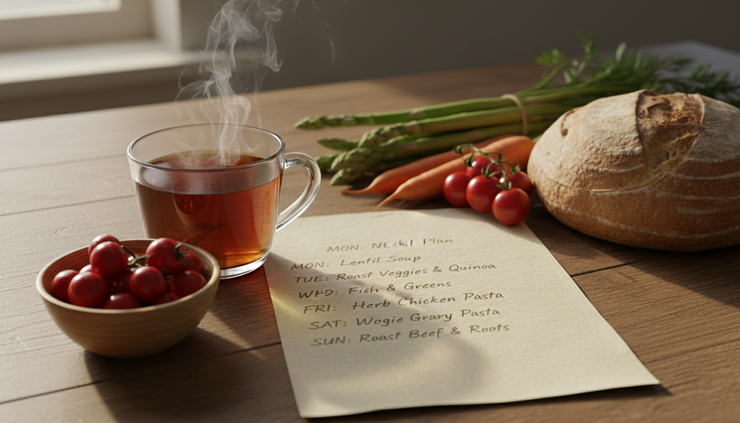
Build a simple week around food first
Hawthorn fits best when the meals already make sense.
Here’s a no-drama way to think through a week.
Pick two breakfast anchors
Choose breakfasts that don’t require much thought.
Good anchors:
Oats with fruit, nuts, and yogurt
Eggs with vegetables and whole grain toast
Plain yogurt with berries, seeds, and oats
Tofu scramble with greens and potatoes
Bean and vegetable breakfast tacos on corn tortillas
Add hawthorn berry only if it fits. A spoon of tart fruit with oats works. A berry tea can work. Don’t force it.
Make one bean dish
Beans are cardio nutrition workhorses. They bring fiber, potassium, magnesium, and plant protein. They also save money.
Make one large pot:
Lentil soup
Black beans with peppers and onions
Chickpea stew
White bean and kale soup
Pinto beans with tomatoes and spices
Use vinegar, herbs, spices, and aromatics before adding more salt. A hawthorn vinegar can fit here like any tart ingredient.
Make one grain
Cook a batch of oats, barley, brown rice, farro, quinoa, or whole wheat pasta.
Then pair it with:
Beans
Greens
Roasted vegetables
Fish
Poultry
Eggs
Tofu
Nuts or seeds
Grains help meals feel complete. Whole grains also bring fiber that refined grains lack.
Add vegetables twice a day
Don’t overthink the vegetable rule.
Use frozen, fresh, canned, raw, roasted, or sautéed. The heart doesn’t care if the broccoli came from a freezer bag.
Easy choices:
Frozen spinach in eggs or soup
Bagged cabbage slaw with beans and rice
Roasted carrots and onions
Salad greens with olive oil and vinegar
Tomato and cucumber with lunch
Frozen mixed vegetables in stir-fry
Salsa on beans, eggs, or fish
The best vegetable is the one that gets eaten.
Put protein on the plate
Protein keeps meals satisfying. It also helps keep snack grazing down.
Use what works for your life:
Fish
Chicken or turkey
Eggs
Beans and lentils
Tofu or tempeh
Greek yogurt or cottage cheese
Nuts and seeds as add-ons
Lean meat in smaller amounts
No single protein wins every meal. Variety helps.
Keep a salt plan, not a salt p
If blood pressure is an issue, salt deserves attention. Panic doesn’t help. Patterns do.
Start with packaged foods. That’s where sodium adds up fast.
Check labels on:
Soup
Bread
Deli meat
Frozen meals
Sauces
Salad dressings
Chips and crackers
Cheese
Canned beans and vegetables
Then make swaps that don’t ruin your meals.
Use low-sodium broth. Rinse canned beans. Use vinegar and citrus. Add garlic, onion, smoked paprika, cumin, basil, oregano, rosemary, ginger, or chili. Keep salty toppings smaller.
Hawthorn berry can help as a tart note, but it’s one tool among many.
The takeaway is simple
Hawthorn doesn’t need hype. It needs context.
The berry is fruit. Treat it like tart fruit. Use it in tea, sauces, vinegars, or small food preparations if you enjoy it.
Leaf and flower are the classic European cardiac herb parts. Treat them with more precision, purpose and respect, especially in extracts, tinctures, or daily formulas.
Real cardio nutrition still starts with meals:
Vegetables
Fruit
Beans and lentils
Whole grains
A protein you already eat
Unsaturated fats
Modest salt when pressure is the issue
Then, if hawthorn still makes sense, name the part, name the form and define the purpose.
Everyday cardio nutrition is the clean whole meal. Hawthorn berry and rose hip earn a place on that plate because the record says fruit is food: cooked, jellied, decocted, eaten with fat in one tradition, stir-fried for a heavy meal in another. Leaf and flower earn a place after the plate because the European record says flowering tops, taken for weeks, were the cardiac herb, and because the better modern numbers were measured on quantified extracts of that part, as adjuncts, in people who already had a diagnosis.
Keep the berry with real meals. Keep rose hips as fruit in the its natural season. Use the cardiac tea or the official extract for a real purpose.
That kind of thinking cuts through most of the confusion. Berry with meals. Leaf and flower with care. Peace.
All information provided on this website, including blog posts, articles, and any related content, is for general informational and educational purposes only. It is not intended to diagnose, treat, prescribe, cure, mitigate, or prevent any medical condition or disease. Always consult a qualified healthcare provider before making any changes to your health regimen, including the use of herbs, teas, foods, or supplements discussed here. The author is not a licensed medical professional, and this content does not replace professional medical advice, diagnosis, or treatment. The author and One Stop Apothecary are not responsible or liable for any adverse effects, consequences, or outcomes resulting from the application or use of any suggestions, preparations, or information presented herein. Any use of this material is at the reader's own discretion and sole responsibility. These statements have not been evaluated by the Food and Drug Administration (FDA). This information is not intended to diagnose, treat, cure, or prevent any disease.
Sources
American Heart Association — “The American Heart Association Diet and Lifestyle Recommendations”Supports the meal-first guidance on vegetables, fruit, whole grains, legumes, healthy fats, protein, and limiting sodium and added sugar.Read the recommendations
National Center for Complementary and Integrative Health — “Hawthorn”Supports information about hawthorn’s forms, limited evidence, side effects, and medication-interaction precautions.Read the NCCIH fact sheet
American Heart Association — “Whole Grains”Supports the discussion of oats, barley, whole grains, and fiber in a heart-supportive eating pattern.Learn about whole grains
U.S. Food and Drug Administration — “Sodium Reduction”Supports the article’s guidance about reducing sodium and choosing less processed food.Read the FDA guidance
References
Pittler MH, Schmidt K, Ernst E. Hawthorn extract for treating chronic heart failure: meta-analysis of randomized trials. American Journal of Medicine. 2003. https://pubmed.ncbi.nlm.nih.gov/12798455/
Pittler MH, Guo R, Ernst E. Hawthorn extract for treating chronic heart failure. Cochrane Database of Systematic Reviews. 2008. https://www.cochranelibrary.com/cdsr/doi/10.1002/14651858.CD005312.pub2/full
Holubarsch CJF, et al. The efficacy and safety of Crataegus extract WS 1442 in patients with heart failure: the SPICE trial. European Journal of Heart Failure. 2008. https://onlinelibrary.wiley.com/doi/10.1016/j.ejheart.2008.10.004
Zick SM, et al. Hawthorn Extract Randomized Blinded Chronic Heart Failure (HERB CHF) trial. European Journal of Heart Failure. 2008. https://pubmed.ncbi.nlm.nih.gov/18490196/
Bernatoniene J, et al. The effect of crataegus fruit extract and some of its flavonoids on mitochondrial oxidative phosphorylation in the heart. Phytotherapy Research. 2009. https://onlinelibrary.wiley.com/doi/10.1002/ptr.2815
Walker AF, et al. Promising hypotensive effect of hawthorn extract. Phytotherapy Research. 2002. https://pubmed.ncbi.nlm.nih.gov/11807965/
Walker AF, et al. Hypotensive effects of hawthorn for patients with diabetes taking prescription drugs. British Journal of General Practice. 2006. https://pubmed.ncbi.nlm.nih.gov/16762125/
Szikora Z, et al. Hawthorn (Crataegus spp.) clinically significantly reduces blood pressure in hypertension: a meta-analysis. Pharmaceuticals. 2025. https://www.mdpi.com/1424-8247/18/7/1027
Tankanow R, et al. Interaction study between digoxin and a preparation of hawthorn. Journal of Clinical Pharmacology. 2003. https://pubmed.ncbi.nlm.nih.gov/12817526/
German Commission E. Hawthorn leaf with flower. https://www.herbalgram.org/resources/commission-e-monographs/monograph-approved-herbs/hawthorn-leaf-with-flower/
European Medicines Agency. Crataegi folium cum flore. https://www.ema.europa.eu/en/medicines/herbal/crataegi-folium-cum-flore
Native American Ethnobotany Database. Crataegus records. http://naeb.brit.org/

Comments